
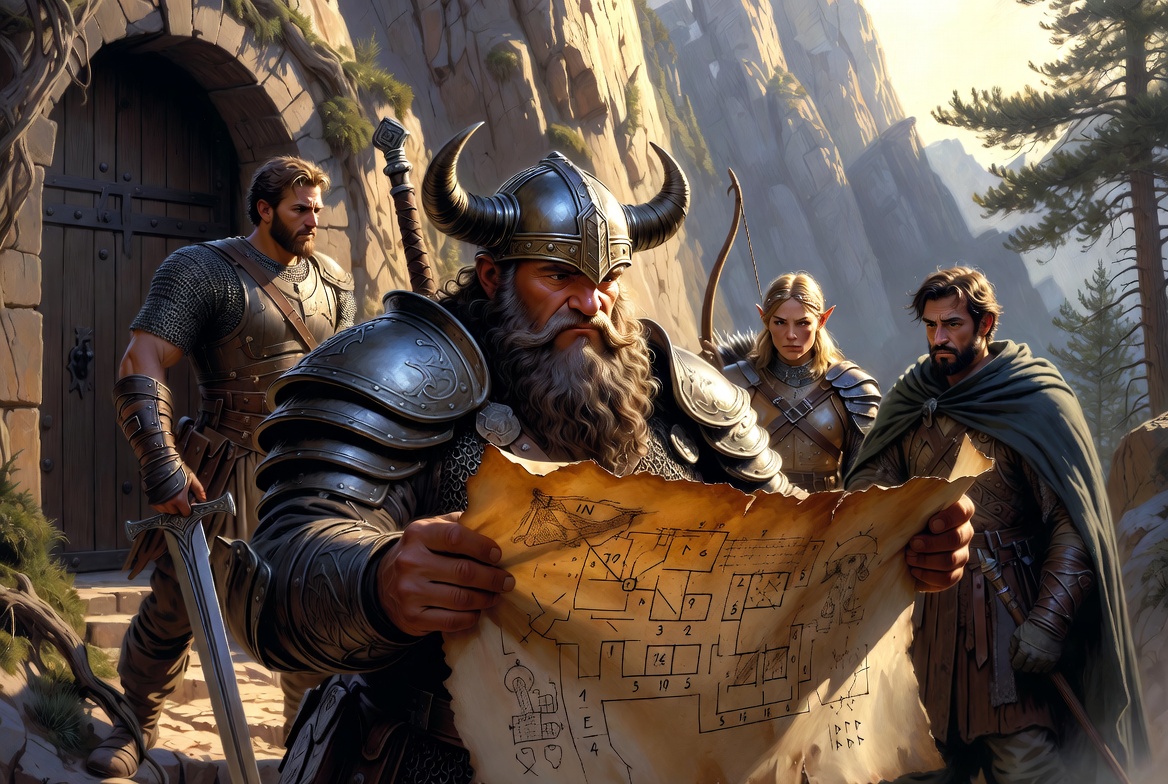
In September 1980, Space Game issue 31 includes a guest writer for the Deus Ex Machina column by Joseph Power that describes an algorithm for generating maze-like dungeons with a personal computer. No source code was included, but the logic is clearly explained. I wanted to see what the maps looked like, and I build a WordPress plugin for generating these maps.
Try making your own Power mazes!
The process involves filling a 2D array of chambers, randomly chosen to fill one more than half the number of cells in the matrix. Chambers in a row all connect to each other horizontally, sometimes requiring corridors that pass through empty cells. Chambers that are vertically adjacent are also connected by corridors. One of the chambers in the first row is considered the entrance. One of the chambers in the last row is considered the exit. This produces a maze that always has a solution.
Here’s what it would have looked like printed out on a dot matrix printer in 1980.
      1   2   3   4   5
  1   *-------*---*
              |
  2       *---*-------*
              |
  3   *-------*-------*
      |       |
  4   *---*---*
      |
  5   *-----------*----*
I added more details to this general idea.
- Each column and each row have a distinct size, chosen randomly.
- Chambers in cells are sized randomly with each cell.
- Corridors connect chambers in a straight line from a randomly-chosen point along the chamber wall.
- If a corridor cannot be drawn between two chambers, one of the chambers is grown to that at lease one 10 foot section overlaps.
- All corridors end in doors. The entrance and exit are also represented as doors.
This produces maps that look like the following.
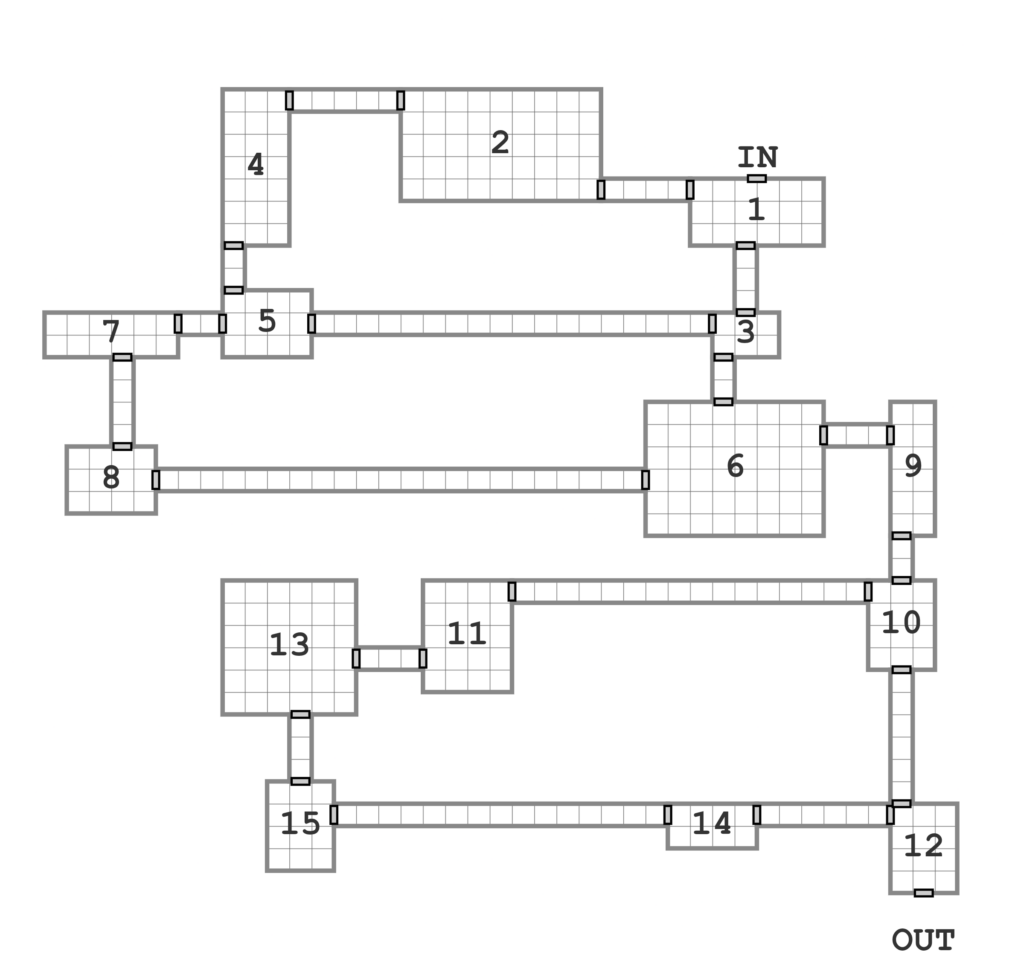
The visual design is simple and idiosyncratic.
- The algorithm guarantees that there will be a path from the start to end.
- The layout hints at how Dwarves might dig out a mine with many long corridors that sometimes expand into larger chambers.
- There are frequently loops, which the OSR crowd considers a kind of magical technique of dungeon design.
- The layout would be easy for players to transcribe at the table since there are no tricks, diagonals or non-rectangular rooms.
- Of course, you could start from this map and embellish it to be more naturalistic. You could make some doors secret and add stairs to put some parts of the map and lower levels.
Compare this to my Secret Quest map generator, which is much more chaotic.
Leave a Reply