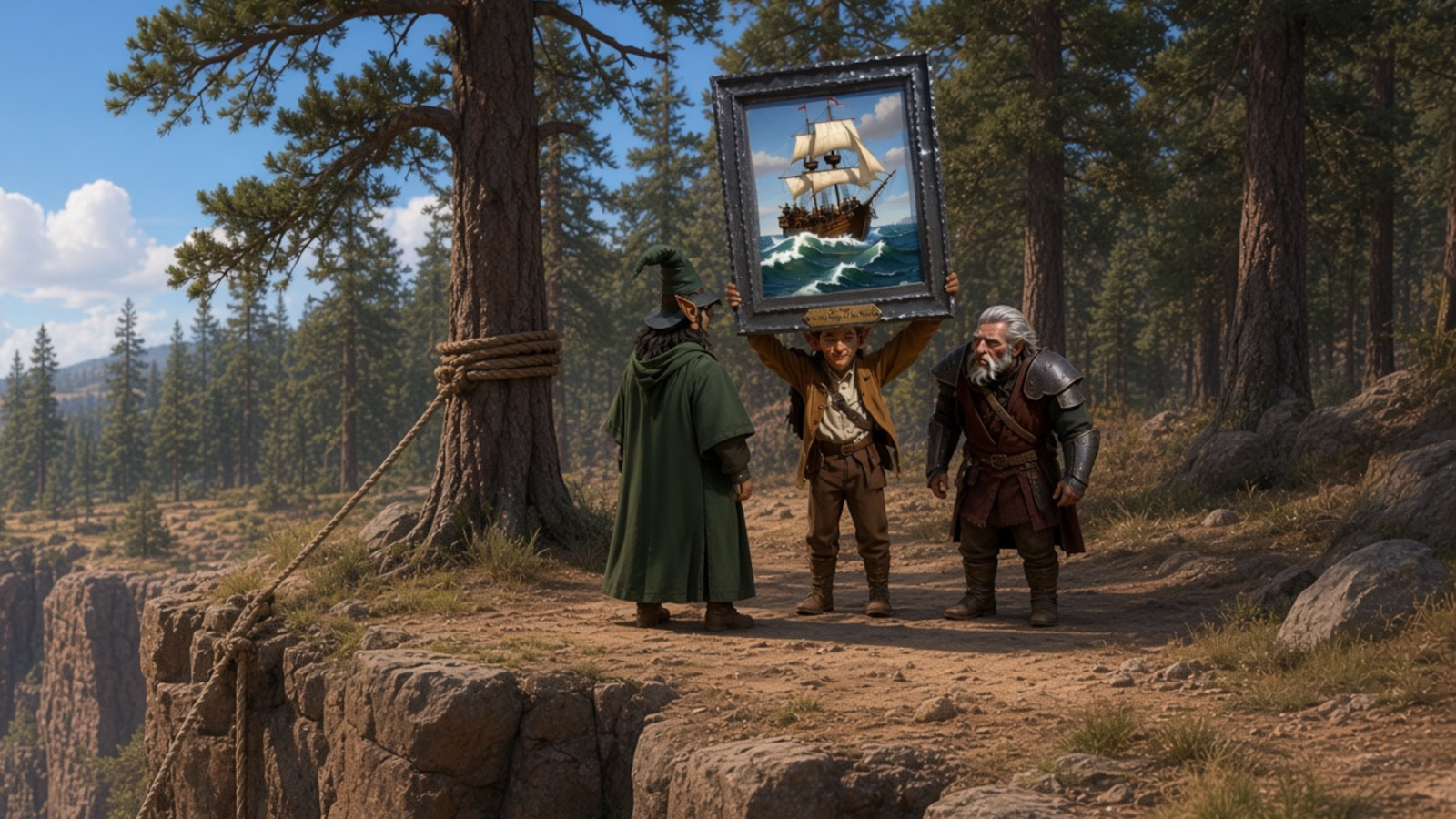
From the lip of a steep ravine, the keen-eyed elf spied the wheel of an upturned wagon. Soon after, the halfling thief descended to investigate. When he returned half an hour later, he brought with him a colorful painting framed in iron. The years of exposure had pitted the frame with rust, but the vivid lines of egg tempura still depicted a crew aboard a three-masted vessel cutting through churning waves. A brass plaque riveted to the bottom edge read “The Voyage to the Edge of the World”.
Several desiccated corpses among the wreckage below were found with half-finished maps and a journal that described an expedition to these wild lands decades before. The documents told the tale of master cartographers who failed in their mission in years past.
Framed in heavy blackened iron egg tempera painting of “The Voyage to the Edge of the World” It was utilized by master cartographers during the mapping of unknown territorial expanses. It is deeply corroded and pitted throughout. (210 gp)
This generator is meant to make interesting relics for adventurers to find among more ordinary treasure. The types are works of art or decorated furniture, perhaps other items of cultural significance. Each has a note about where is came from or who owned it, plus a note about the current conditions. The details might provide a spark of inspiration for the party’s next adventure.
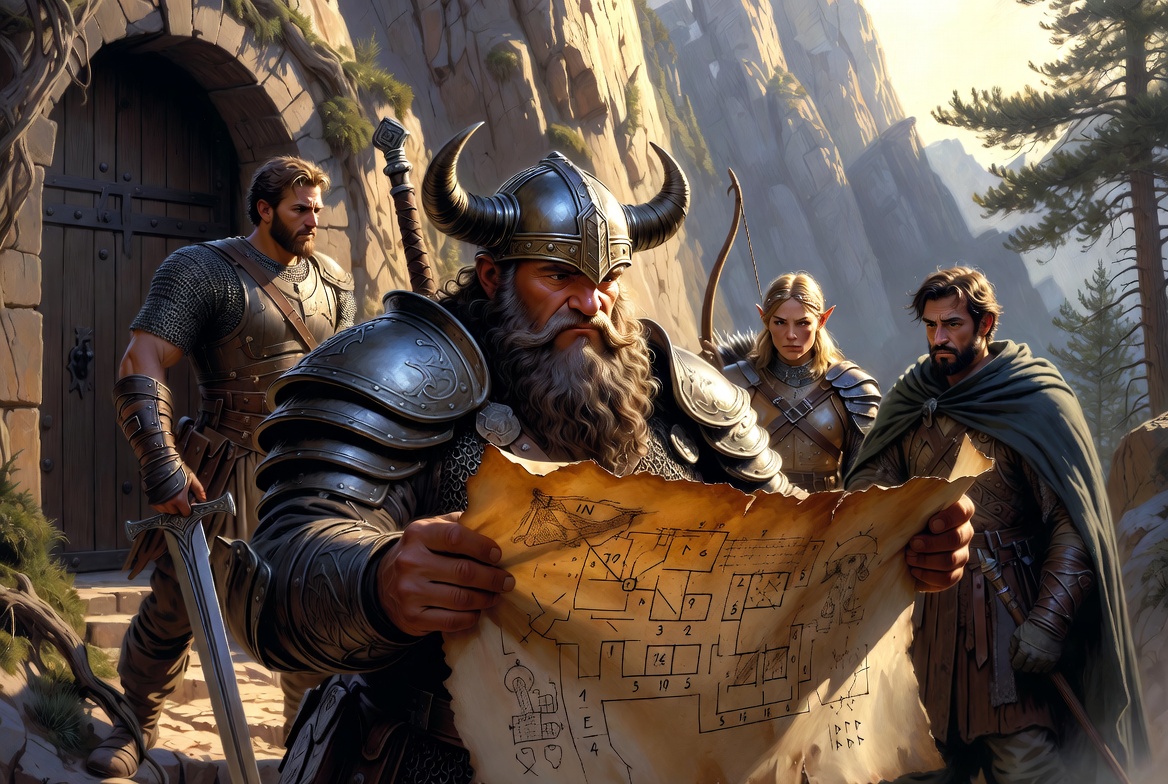
In September 1980, Space Game issue 31 includes a guest writer for the Deus Ex Machina column by Joseph Power that describes an algorithm for generating maze-like dungeons with a personal computer. No source code was included, but the logic is clearly explained. I wanted to see what the maps looked like, and I build a WordPress plugin for generating these maps.
The process involves filling a 2D array of chambers, randomly chosen to fill one more than half the number of cells in the matrix. Chambers in a row all connect to each other horizontally, sometimes requiring corridors that pass through empty cells. Chambers that are vertically adjacent are also connected by corridors. One of the chambers in the first row is considered the entrance. One of the chambers in the last row is considered the exit. This produces a maze that always has a solution.
Here’s what it would have looked like printed out on a dot matrix printer in 1980.
Each column and each row have a distinct size, chosen randomly.
Chambers in cells are sized randomly with each cell.
Corridors connect chambers in a straight line from a randomly-chosen point along the chamber wall.
If a corridor cannot be drawn between two chambers, one of the chambers is grown to that at lease one 10 foot section overlaps.
All corridors end in doors. The entrance and exit are also represented as doors.
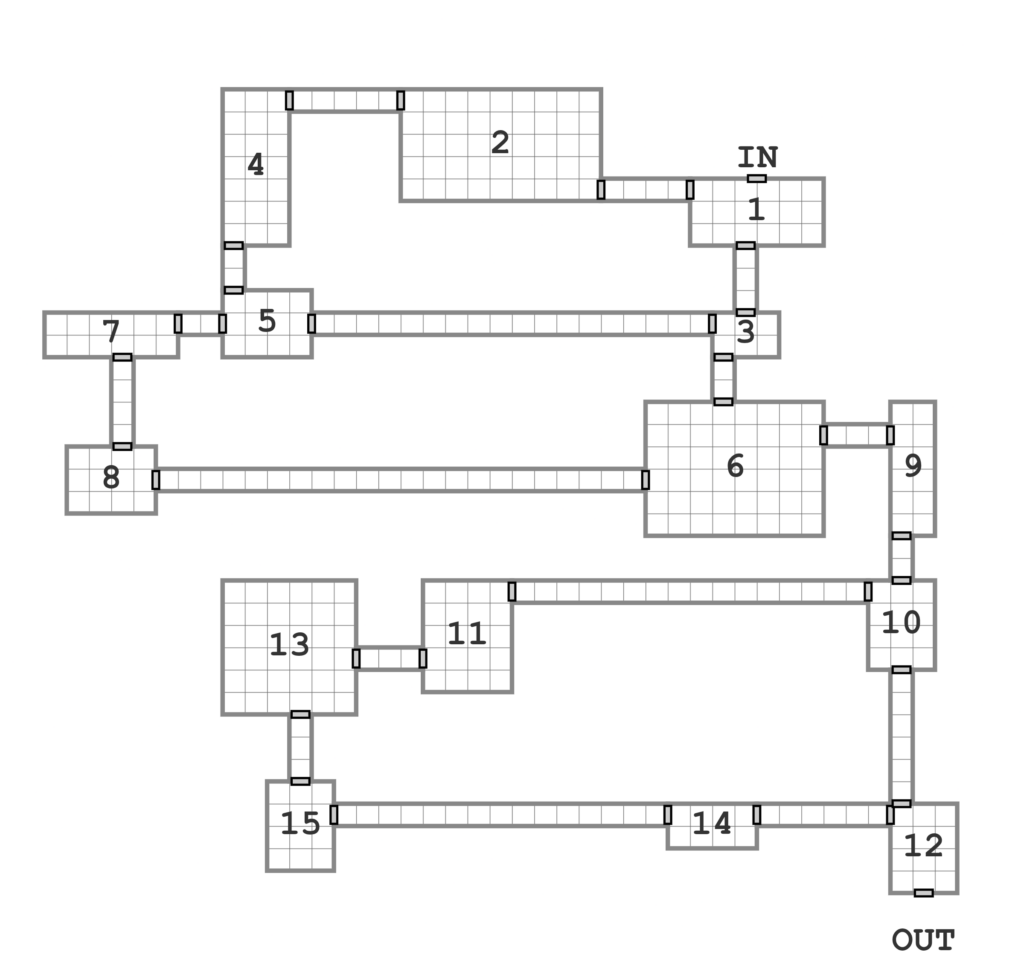
This produces maps that look like the following.
The visual design is simple and idiosyncratic.
The algorithm guarantees that there will be a path from the start to end.
The layout hints at how Dwarves might dig out a mine with many long corridors that sometimes expand into larger chambers.
There are frequently loops, which the OSR crowd considers a kind of magical technique of dungeon design.
The layout would be easy for players to transcribe at the table since there are no tricks, diagonals or non-rectangular rooms.
Of course, you could start from this map and embellish it to be more naturalistic. You could make some doors secret and add stairs to put some parts of the map and lower levels.
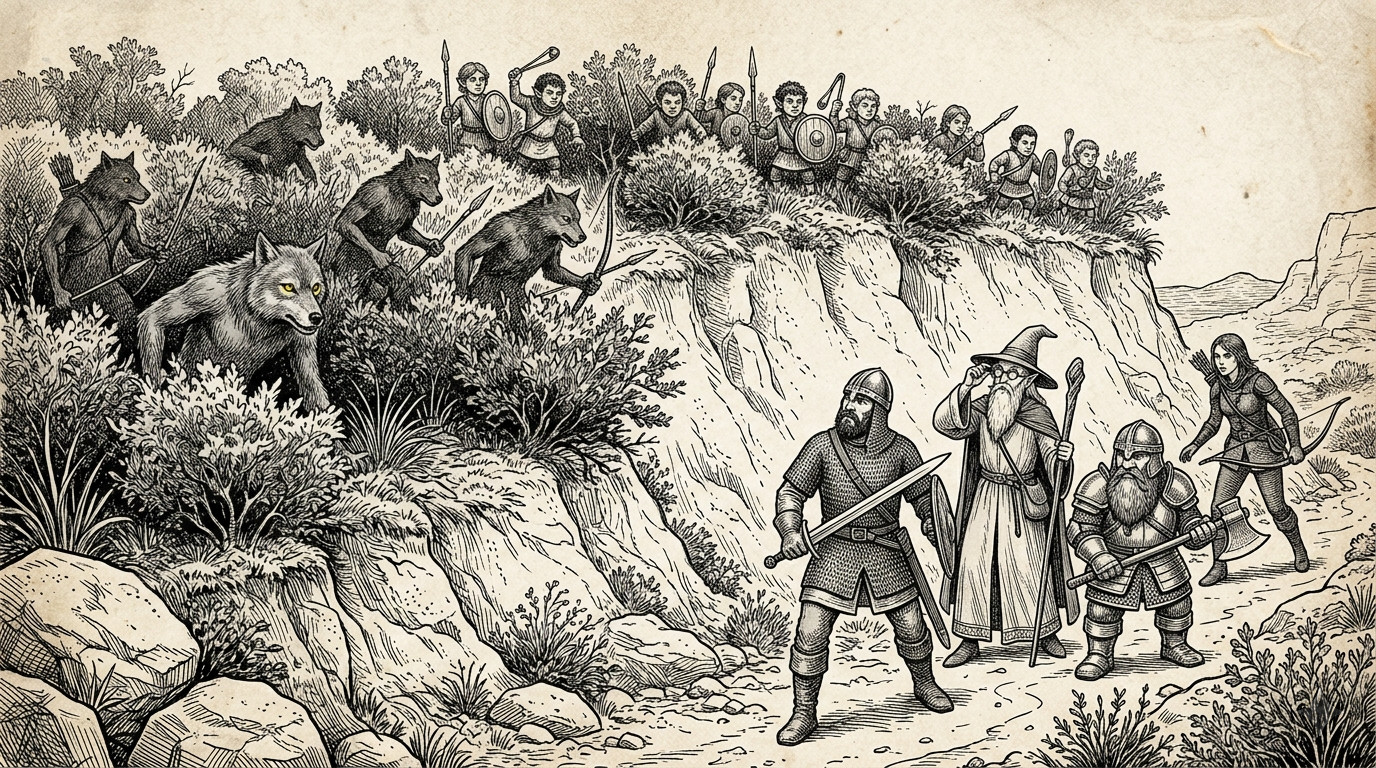
The party has been skirting the perimeter of a tabletop hill with a steep incline rising 20 feet of hard-packed clay. Above and below, thick brush offers numerous opportunities for hiding. Yet just now, the gray fur of a wolf rises over a bush. Yellow eyes bear down on the party with a human intelligence. Seven other humanoid shapes drift between the vegetation.
These eight figures are Lupin, humanoid wolfmen, nearly indistinguishable from werewolves but steadfast enemies of such. They are merely hunting small game, and as such, present as cautious and likely to move off to avoid entanglements with the party.
Meanwhile, 11 Halfling warriors have been tracking the Lupin for days. The diminutive fighters hide at the edge of the rise, spears at the ready. They are hunting the Lupin under the mistaken notion that they are werewolves who took several of their flock of milk goats. They will watch for three rounds before taking advantage of their elevated position to fire stones with slings, hoping to incapacitate one of the Lupin for questioning.
The scrub in the area provides an advantage of +2 or +10% to hiding attempts. It provides half cover. The edge of the hill is steep enough to prevent easy climbing, though the dirt is hard-packed. Any who wish to get to the top will likely have to loop around to the backside, some 100 yards.
8 Lupin: AC 14, HD 2, #At 1 silver spear or arrow, Dam 1d6, Mv 120′, Sv F2, Ml 8, XP 75
While exploring, the party encounters figures wandering 60 yards (20 if surprised) to the northeast. 8 Lupin AC 14, HD 2, #At 1 silver spear or arrow, Dam 1d6, Mv 120′, Sv F2, Ml 8, XP 75 Resemble werewolves. Lawful nomads. Hate werewolves, recognize them automatically, attack on sight. 3 rounds later followed by 11 Halflings AC 13, HD 1-1, #At 1 weapon, Dam Spear (two handed) 1d8, Mv 40′, Sv F1, Ml 8, XP 25
Their attitude is that there is clear and present danger. They are cautious and aware of possible trouble. They will disengage without violence if possible, or provide a final warning.
Their surprise roll is 5, and the party rolls 5.
The immediate area is heath and bushes, with half cover possible and concealment for prone or small creatures (+2 bonus to stealth while moving slowly). The ground is a steep-sided mesa edge that rises 20′, and footing is firm packed earth. Nothing much else distinguishes the area..
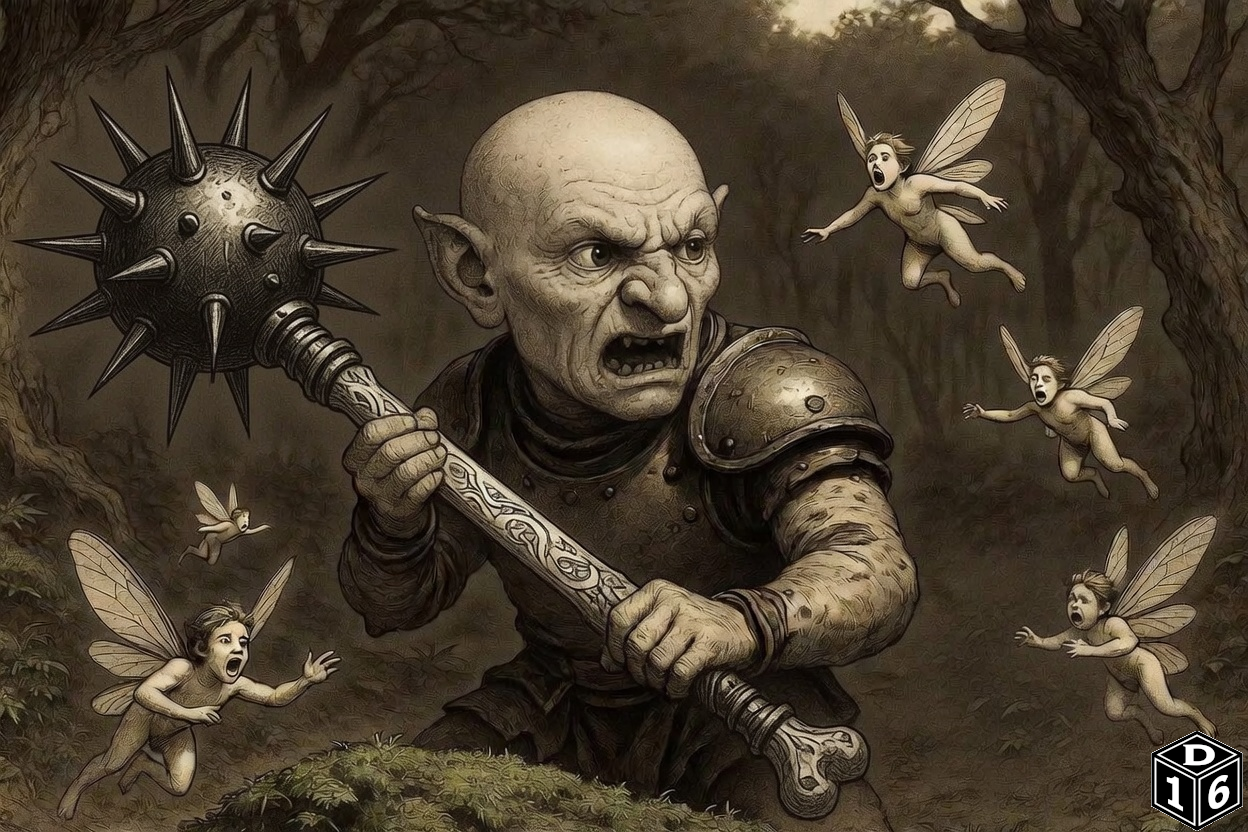
Exactly 333 years ago, the infamous halfling Menegildiloth, whose reputation for reviving broken weapons was almost eclipsed by his abject unreliability, acquired a most fearsome armament in an unfortunate state of disrepair. The morningstar presented in two segments, spiked ball and bone shaft, propelled itself into his collection by way of the sole survivor of a delver into that pit of decrepit doom called Kaalun. The irregular globe with muricate surface that once proudly stood affixed to the calciferous pole whispered to him in voiceless words. The witless adventurer sought only a pittance for the engraved bone. Menegildiloth stifled a chuckle as he handed over a 18 pieces of silver.
Down in his underground forge, the diminutive weaponsmith toiled to remake the two parts into a whole once more. All the while, gentle waves of arcane insight caressed his mind, as the weapon itself bade him to restore its glory. The shaft was carved of dragon bone and likewise engraved with a dragon motif, the ridges of intricate dragon scale ensuring a steady grip. The dread weapon offered an alliance against the enchanted creatures of the Sucnaathoth Glade, those careless monsters of arcane origin who once wronged Menegildiloth.
Its champion has long passed from this plane, but the Crepuscular Beacon remains a potent antidote to any enchanted foe, and any who take it up will enjoy a pleasant babbling of advice and nonsense.
This Morningstar +1, +2 vs Enchanted is imbued with a modest intelligence and the ability to communicate telepathically with its wielder. It lusts after destruction of enchanted creatures, but with only an ordinary ego, it may fail as often at succeed in compelling the owner to violence.
Morningstar +1, +2 vs Enchanted Intelligent (7 INT 12 WIS 8 CHA).
It was forged 3 centuries past and has need of repair. A shifty mentor known for reforging broken weapons made it to create a legacy of cursed power. Engravings with a dragon motif spiral down the length of the item.
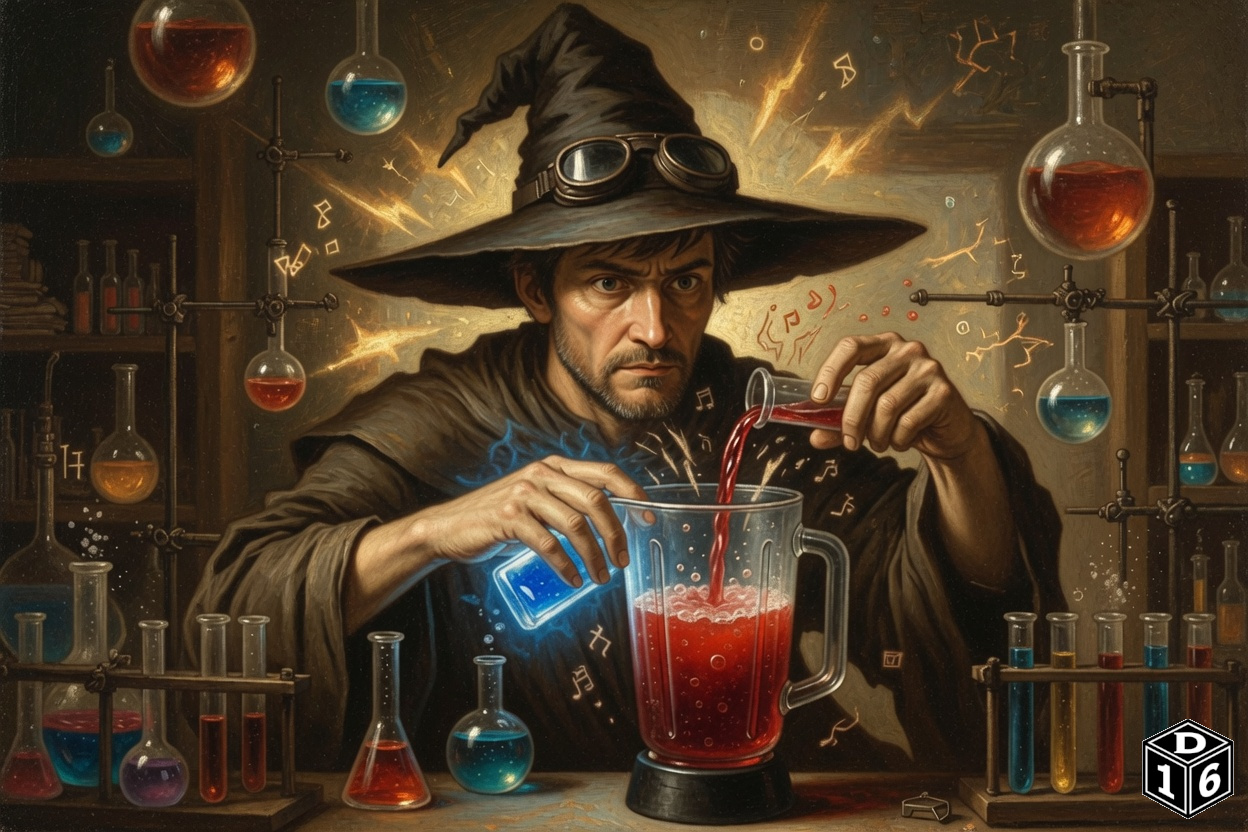
Markov Chains provide an easy way to generate unique names that seem plausible based on a list of familiar names. The Name Blender generator on One Dice Six implements this idea.
You need names for people, places and things in your fantasy world. You can work from historical lists, such as census data. This can produce names without the right flavor (Fred the Barbarian), or they can seem unoriginal (Gandalf the Wizard). You can use use a trick such as using the middle name of a well-known character (Captain Tiberius). You can use an AI and get Lyra or Chen, over and over. You can certainly just wing it, which can lead to unintended reuse, such as The Inn of the Dancing Frog having a rival next door called The Inn of the Dancing Toad.
Here’s another method that’s fast, makes unique names and generally produces names that all seem somewhat similar.
The trick is to use a Markov Chain. The technique starts with a list of names that you wish to model. The names are scanned over as a sequence of letters. Take a slice of the name, maybe 3 or 4 letters, and then look at which letter comes next. Here’s a list of first names that begin with “ste”.
Steele
Stefan
Stefano
Stella
Stellan
Stephan
Stephanie
Stephen
Stephon
Sterling
Stetson
Steve
Steven
Stevie
The letters that appear as the fourth letter are e, f, l, p, r, t, and v. Note that p appears 4 out of 14 times, and v appears 3 out of 14 times. Now, imagine we’re trying to come up with a new, unique name and we’ve picked letters at random up to having “ste”. We could construct a lookup table to pick the fourth letter at random.
1d100
Next Letter
1-7
e
8-21
f
22-35
l
46-63
p
64-70
r
71-77
t
78-100
v
Roll a 55, and the result is p. Now you have “step”, so you refer to the lookup table for “tep”, and so forth. Except, this would be incredibly tedious if done by hand. Computers are great and analyzing a long list of names and building the many lookup tables. Furthermore, the technique is simple enough to run in your browser. Thus, we have Name Blender.
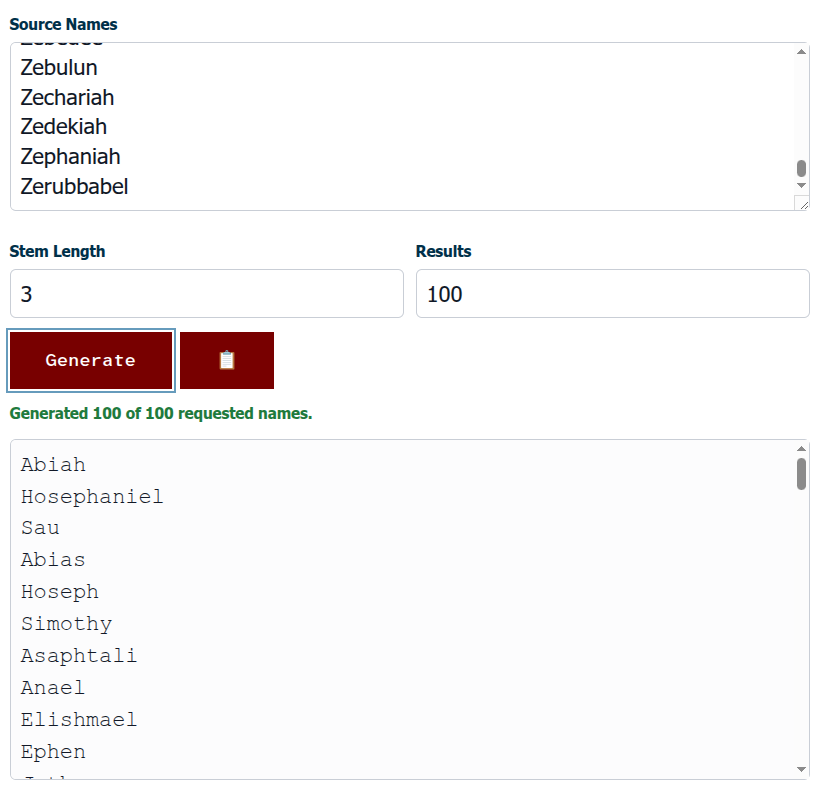
Choosing a source list relies on your creativity and how many names you start with. In the example above, I’ve started with 172 names found in the bible. You can see with names like Hoseph and Simothy, they are clearly reminiscent of names we all recognize but they aren’t in the source list. You can get really far using names from various cultures, but what gets really interesting is when you mix two lists together.
For example, I mixed biblical names with the 40 most popular baby names in Sweden and came up with names like Agnesimus, Malter, and Gabram. This works for place names, too. I mixed up the names of the top cities in the US and came up with Marbond, Windido, Dester, Saukeeport, Stinsonia. From ancient Greek city names I got Olynth, Phermum, Patracus, Lamphidna.
The longer the stem length, the fewer possible results there can be and more regular the results become. Short stems tend to give results that seem more random.
Lists of names are readily available on the Internet. Many times these lists need to be edited into just the names. You can also ask an AI to produce a like with a prompt like “give me a list of 100 Chinese given names suitable for warriors/generals from the Genghis Khan era”.
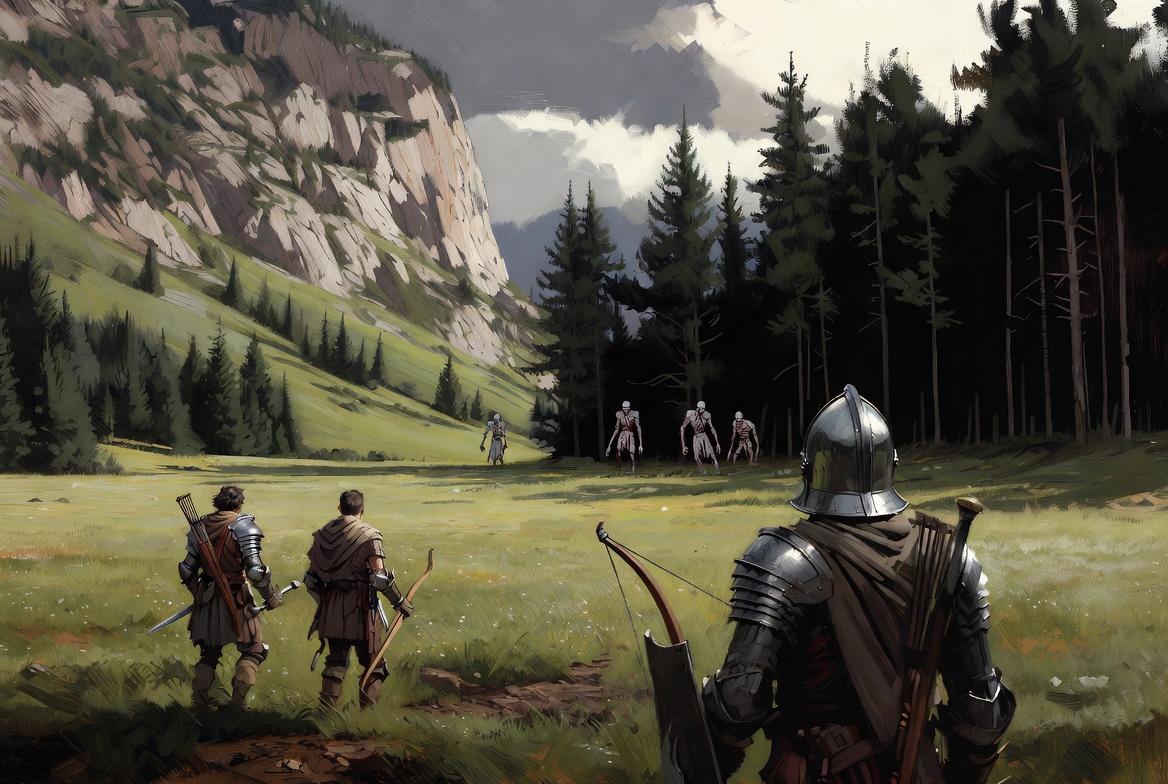
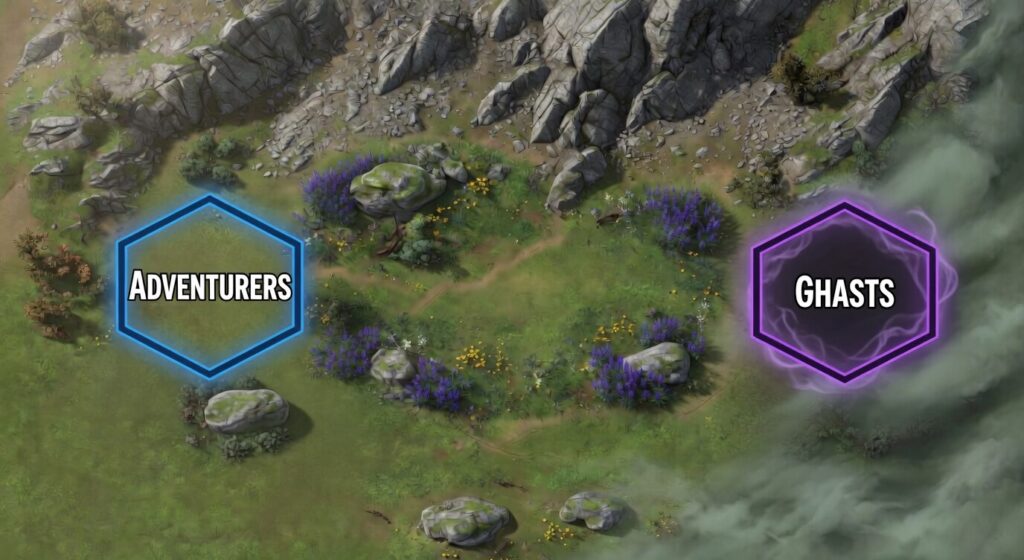
The party pauses at the western edge of an alpine meadow, where the tall pines part to let tall grass sway in a gentle breeze that tumbles down the steep incline from the northern peak. The snow-chilled air raises the fine hairs at the back of the neck. At the eastern extreme, just 60 yards distant, the lurching shapes of four figures turn to squint at you and your companions.
Instantly, you recognize them as ghouls or ghasts, disgusting undead creatures deserving nothing but utter destruction. The distance could be closed in a mere 10 seconds if both sides rushed at each other, but the ghasts pause, as if wondering if they might rather talk than fight.
The high ground is to your left, should you wish to circle around the edge of the meadow to gain advantage. If you wish to speak to the ghasts, they may angrily agree to eat just one of your number and let the rest retreat.
While exploring, the party encounters figures wandering 60 yards (10 if surprised) to the east. 4 Ghasts AC 15, HD 2**, #At 2 claws/1 bite, Dam 1d4/1d4/1d4 + paralysis + stench, Mv 30′, Sv F2, Ml 9, XP 125, Tr B
Their attitude is that they must trust and verify. They are neutral and open to a fair exchange. Apply +4 to the next check. Any final offers are take-it-or-leave-it.
Their surprise roll is 3, and the party rolls 4.
The immediate area is an alpine field of grass with clear line of sight. The ground slopes steeply up to the the north (+2 AB from higher ground), and it is hard rock or packed dirt. No water features are nearby.
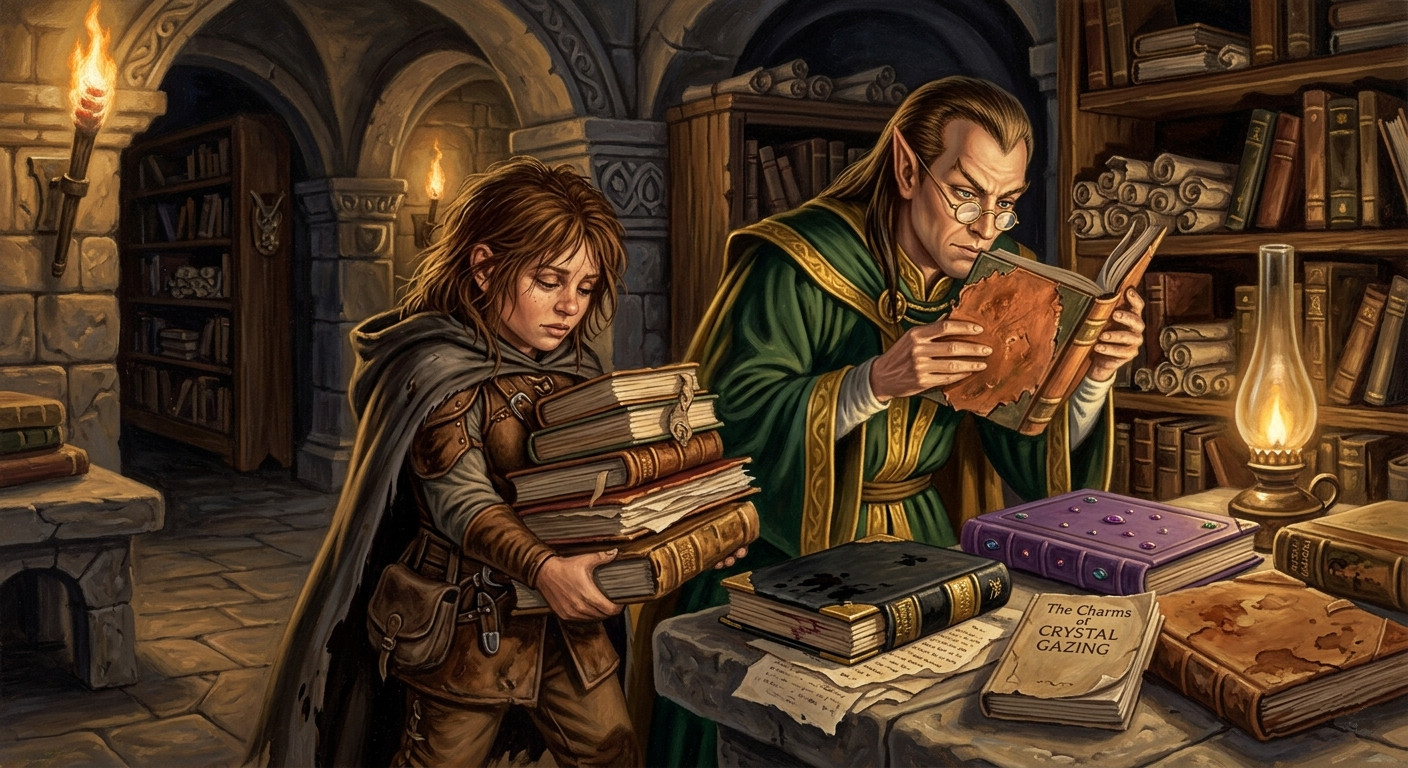
After ten minutes of searching, the halfling thief returned from the library with a stack of eight books that teetered as she shuffled back to the party. The Elven wizard adjusted his spectacles and began taking one book at a time, examining them and reciting the titles.
“This volume bound in black pigskin describes magical herbs, as I note by reading the gilded title on the spine. Oh, but the pages are all soiled by ink stains. Tanzil Jae was a prolific author in his day, but is quite obscure now.”
“Now, this handsome volume in rare violet calfskin is a religious history of the inquisitors who cleansed the Piekaff Valley 300 hundred years ago. It’s part of a rather tedious series of 13 volumes each dealing with the exploits of various witch hunters. With so many pages torn out, I wouldn’t think it’s worth much, but these gems attached to the cover may be worth prying off, dear thief.”
“It does not appear that this unusual book with the copper cover has faired well. Not surprising given its subject: conjuring demons. I can barely make out the words on these scorched pages!”
“This old book with the paper cover is worthless. See how it crumbles as I turn the pages? Bah! It is only part of a larger collection on animal husbandry.”
“I believe I will keep this small book with the paper cover. The Charms of Crystal Gazing by Malibart Churd. It’s well-worn, so I conclude it was either quite useful or quite inscrutable to its previous owner.”
“Further Achievements of the Great Cathedral Builders by Stanisgurt Kloptikon This black cowhide is also quite worn. Art bores me.”
“Here is another worn-out art book covered in yellow deerskin. It seems to instruct on sketching.”
“Finally, we have another bejeweled cover, this time in red pigskin, all about realms inhabited by demons and devils. I’m not surprised this one is vandalized as well. See if you can dig those gems out of the cover, runt.”
This book’s cover is pigskin dyed black with gilded spine. The condition is poor, ink stains obscuring a fair amount of the pages. The subject is herbs with a focus on magical herbs, a single volume, written by a prolific but obscure author.
This book’s cover is calfskin dyed purple and ebedded with gems. The condition is vandalized, missing many pages. The subject is religious history history, a single volume of a larger work with 13 volumes.
This book’s cover is copper plates, green with verdigris. The condition is badly damaged, nearly illegible. The subject is conjurings within the field of demonology, a single volume, written by a prolific but obscure author.
This book’s cover is heavy paper. The condition is ancient. Pages crumble as they turn. The subject is animal husbandry, a single volume of a larger work with 9 volumes.
This book’s cover is heavy paper. The condition is worn and tattered. The subject is crystal gazing as a branch of divination, a collection of works all by the same author.
This book’s cover is cowhide dyed black, the title branded into the cover. The condition is worn and tattered. The subject is cathedrals and chapels in the realm of art, the sequel to a book by the same author.
This book’s cover is deerskin, stained yellow. The condition is worn and tattered. The subject is sketching in the realm of art, an edition of a regularly published book with multiple authors.
This book’s cover is pigskin dyed red and ebedded with gems. The condition is vandalized, missing many pages. The subject is fiendish realms within the field of demonology, a single volume, written by a well-known author.
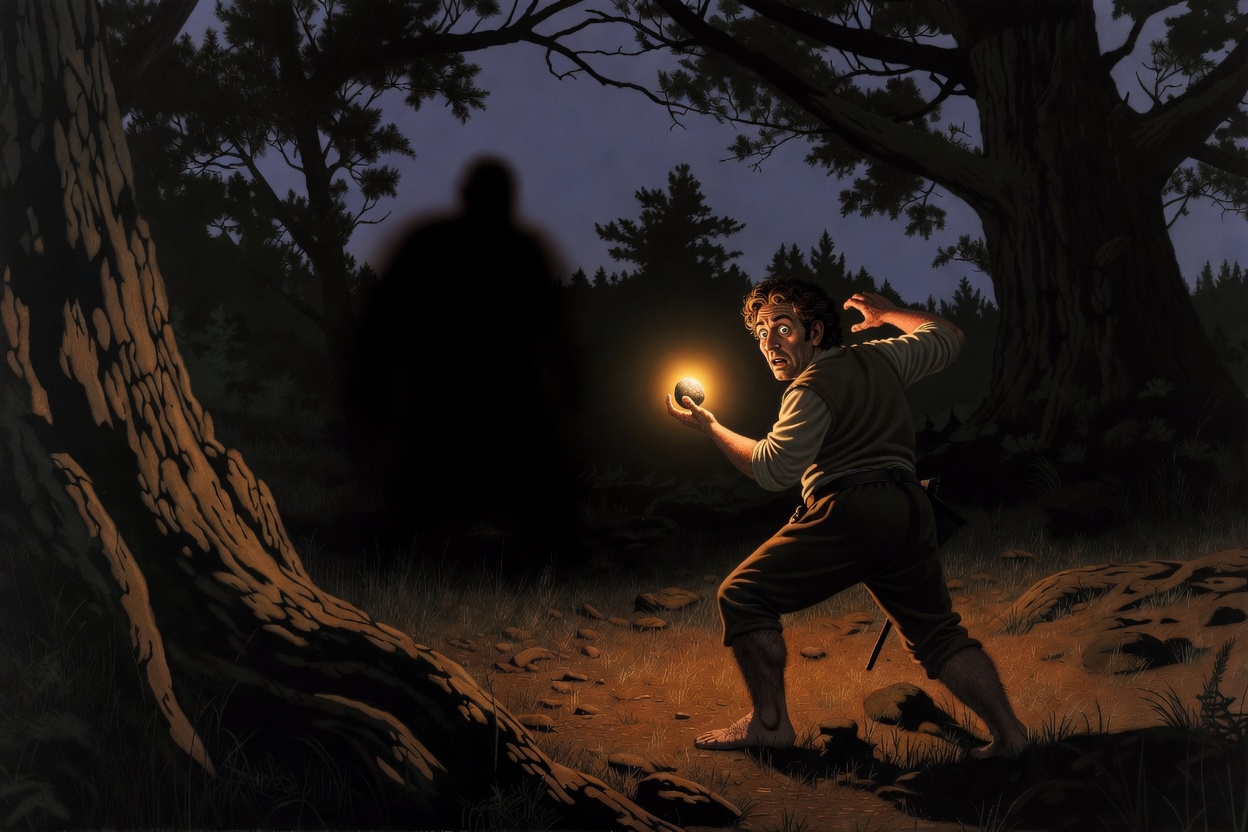
This simple stone glows as bright as a candle when gripped in the hand. It functions as a magical weapon, able to harm all enchanted monsters for 1d4+1 points of damage when thrown. It adds +1 to attack bonus.
The stone contains the soul of a celestial being who wagered with a devil over whether a mortal would choose wisely in the face of temptation. As payment for the loss, the devil condemned his opponent to a thousand years in the form of a stone discarded in a stream.
Nearly a hundred years ago, a humble halfling named Alfred plucked a shiny stone from the creek near his home and was surprised to find it glowed as bright as a candle when held. He stuffed it in his pocket and sometimes brought it out as a curiosity, a minor magical device that helped him avoid tripping over tree roots while heading out to fish in the pre-dawn darkness.
He never told anyone else that the stone whispered to him, encouraging him to keep his faith and to always treat others with honor. Surely the stone could not truly be alive with a real consciousness, he thought. In some particular moments of weakness, Alfred was sure the stone had forcibly turned away an intrusive thought to insult another or to take more than his share at the annual harvest celebration.
One morning, he stepped past the old oak into a particular dark patch of shade, and he felt the bone-deep chill that comes from the touch of a Shadow, those terrible monsters who sap their victims’ strength. Reacting instinctively, he leaped backwards, pulled the stone from his pocket and hurled it at the nasty Shadow. No ordinary stone could harm such an enchanted creature, but the fortune favored that diminutive fisherman that morning. The magic of the stone dissipated the magical darkness of his foe. From that time, Alfred called his stone Shadowbane.
Stone +1 Glows as a candle when held. Intelligent (11 INT 12 WIS 15 CHA).
It was forged roughly a century ago and still appears new. A divine being made it to fulfill a divine wager. The item is utterly plain, its surface polished to a mirror sheen with no engraving or motif to betray the enchantement woven into its steel.
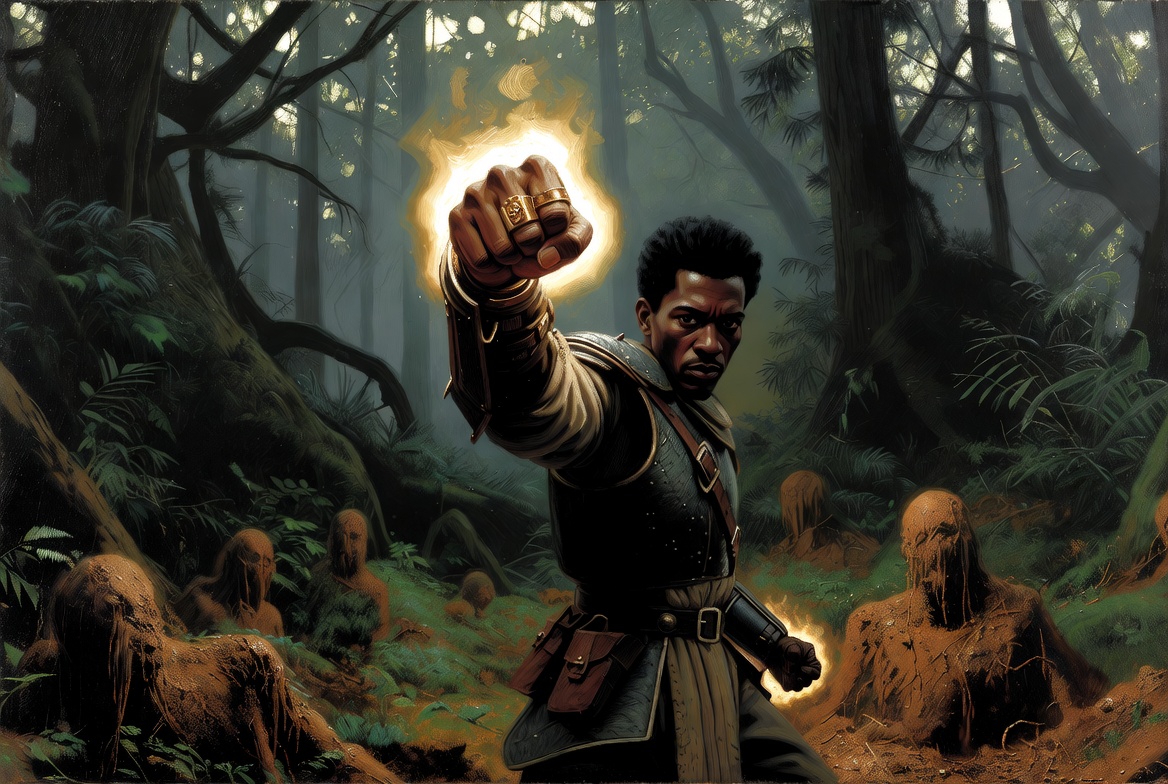
This gold band allows the wearer to summon 1d12 beings that fight beside him as zombies for up to an hour. To activate the ring, the wearer must recite the oath engraved along its surface: “Dust and ashes, protect my flesh!”
The figures are formed from nearby soil over 1d6 rounds, and the effect fails if there no suitable material within range. They behave as zombies created from an animate dead spell, including hit dice, attacks and movement. However, they are made from mud and resemble the ring wearer’s ancestors.
This gold ring, engraved with symbols, was created by spirits and given to mortals as reward for some great deed. The ring provides the following powers. Call 1d12 zombies once a week for 1 hour.