News

  • The Lingering Draught of Mnemonic Dissolution

    The Lingering Draught of Mnemonic Dissolution

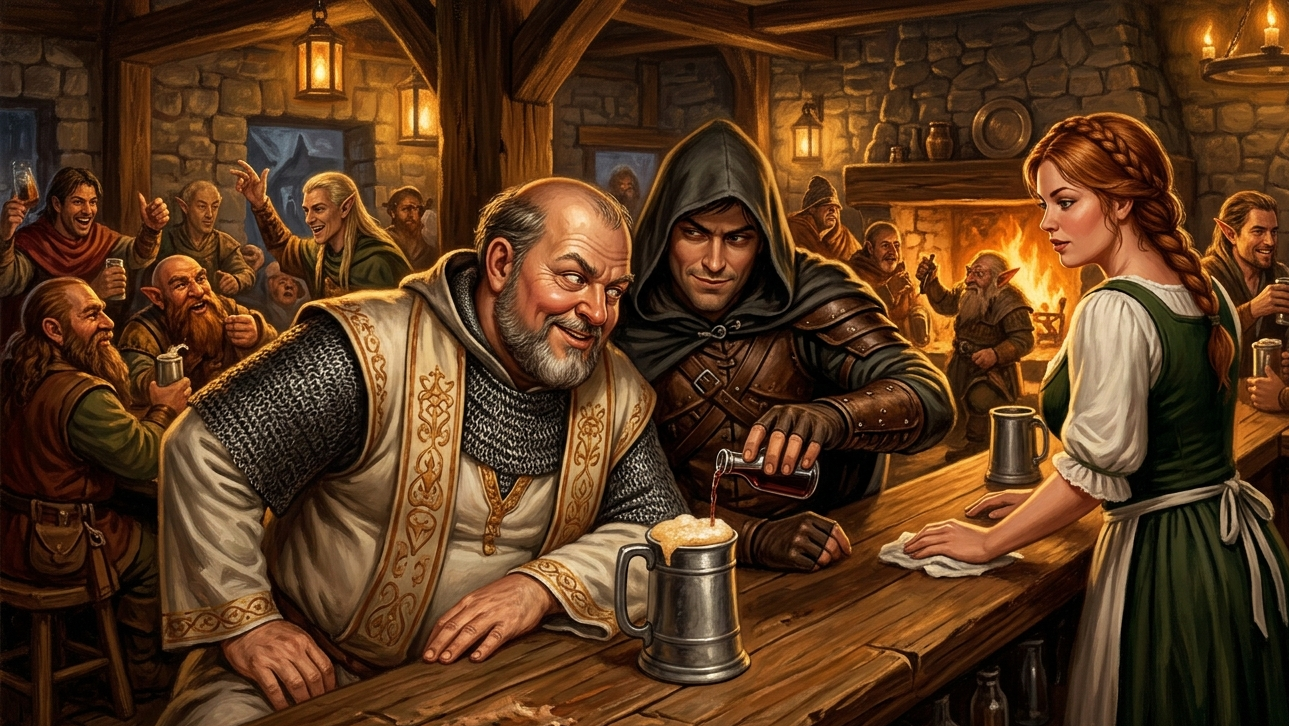
    This potent poison must be poured into a victim’s beverage, making it more the subtle tool of the nefarious assassin rather than of an aggressive thief engaged in battle. Once consumed, the poor imbiber must save versus poison at a -2 penalty, else 1-4 hours later, he will find 1d6 of his memorized spells gone from his mind.

    With a little planning, that indulgent cleric at the inn might find himself lacking in prepared spells later that evening just at the moment when he’s confronted in a dark alley. Best to cast purifying spell over your drinks if you frequent the taverns near the wharf.

    Here’s the original output from the generator.

    This poison is delivered by ingesting. Its strength is considered strong -2 to save. Its effects are felt in 1d4 hours. The poison causes memory loss, save vs poison or lose 1d6 memorized spells. The effects are permanent and may not be reversed except by a wish.

  • Manticores in the Mud

    Manticores in the Mud

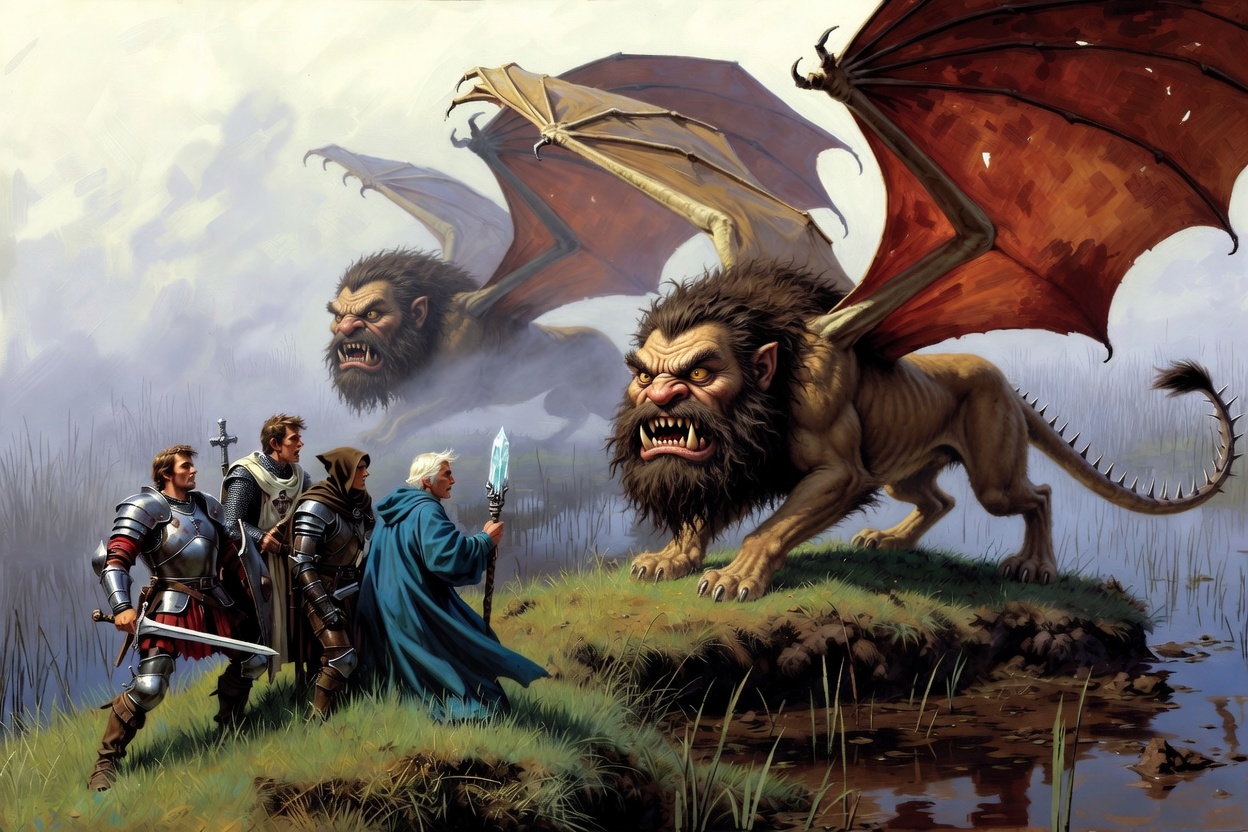
    While exploring the wetlands north of St. Orlan, the party comes upon a pair of manticores who have landed on an island of dry land among an expanse of deep muck. Just at this moment, the monsters have not noticed the party, giving them a chance to turn and slip away unnoticed. If they press forward, they will find the manticores wary, and ready for a fight. Yet, at only 30 yards away, the party might rush forward and get a few strikes in before the monsters can respond.

    The morning air is crisp and thick with the dew of Spring. The path being traveled narrows and ends here, leaving only a morass of deep mud that would easily rise to to meet the waist of a full grown man. Anyone foolish enough to enter that muck would need to save vs. death each round, adding their strength bonus, just to make any progress.

    2 Manticores AC 18, HD 6+1*, #At 2 claws/1 bite or 6 spikes (180′ range), Dam 1d4/1d4/2d4 or 1d6 per spike, Mv 40′ Fly 60′ (10′), Sv F6, Ml 9, XP 555

    HP 30☐☐☐☐☐ ☐☐☐☐☐ ☐☐☐☐☐ ☐☐☐☐☐
    ☐☐☐☐☐ ☐☐☐☐☐
    31☐☐☐☐☐ ☐☐☐☐☐ ☐☐☐☐☐ ☐☐☐☐☐
    ☐☐☐☐☐ ☐☐☐☐☐ ☐

    Manticores appear as overgrown lions with thick leathery wings and an ugly humanoid face. Their tails end in 24 spikes, of which they can fire six at a time. Out on the hunt and away from their lair, they carry no treasure, but would certain enjoy a breakfast of human flesh.

    I created this based on the following output from the St. Orlan swamp encounter generator.

    While exploring, the party encounters figures wandering 80 yards (30 if surprised) to the west.
    2 Manticores AC 18, HD 6+1*, #At 2 claws/1 bite or 6 spikes (180′ range), Dam 1d4/1d4/2d4 or 1d6 per spike, Mv 40′ Fly 60′ (10′), Sv F6, Ml 9, XP 555, Tr D

    Overgrown lion with thick leathery wings and an ugly humanoid face. Tail ends in 24 spikes.

    Their attitude is that there is clear and present danger. They are cautious and aware of possible trouble. They will disengage without violence if possible, or provide a final warning.

    Their surprise roll is 2, and the party rolls 5.

    The immediate area is grassy wetland with clear line of sight and easy movement. The area is a waist-deep bog, requiring save vs death +STR or be stuck for one round, and footing is sucking mud. No other natural annoyances are present..

    The general vibe is “crisp”.

  • Estates of the Eliari

    Estates of the Eliari

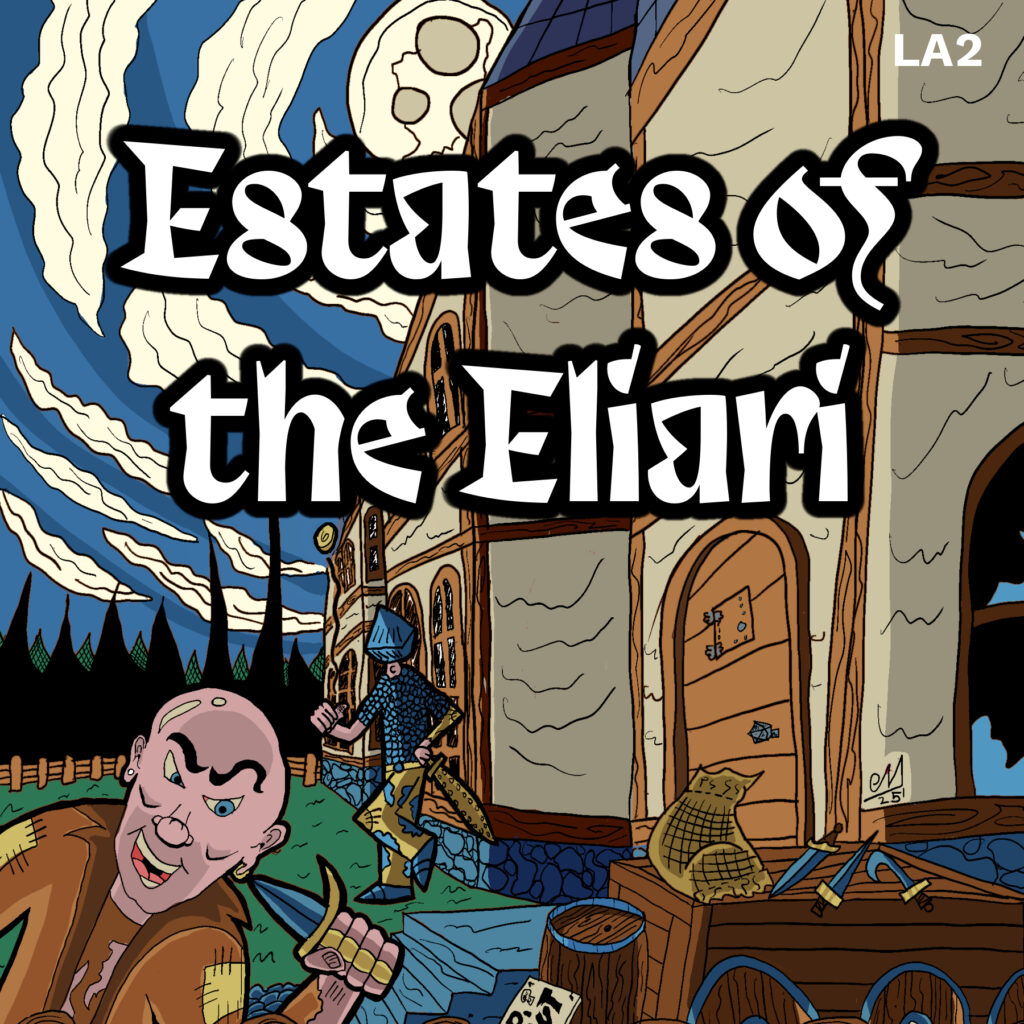
    Today, I’ve released a generator for the Estates of the Eliari module.

    Back in 2022, I was curious about whether I could build a random generator for entire dungeon that made more sense than the traditional, purely-random variety, such as those that come out of Appendix A. I was also thinking about Frontier Forts of Kelnore, the 1978 supplement published by Judges Guild. That supplement had a map that you might have to modify based on a few results, such as “a 5 foot ditch was dug around the walls”.

    I built a generator based on Frontier Forts it to get an idea of what it could produce. You can see how the results are relatively sparse, though I remember reading that players had fun with it when it was first available. I knew I could do something much more complex. And when I got into it, I discovered it was a lot of fun to keep coming up with alternate results. It was something like a solitaire version of the short-form improv game “New Choice” aka “Change”, where a bell rings and you must come up with a different response.

    This experience is similar to that of abductive reasoning that we use when making sense of random results in TTRPGs. In fact, preparing this generator was much like the whole process in reverse because I started from one result and asked my muse to tell me about how it could be different, all the while keeping in mind the context of the other parts of the adventure location. And added challenge is making sure that one result won’t introduce a contradiction that ruins verisimilitude.

    I had so much fun grinding through the possibilities, I thought others would like to join in. I posted the unfinished manuscript to the BFRPG forum, hoping for some collaboration. I didn’t get much on the creative side, so eventually built out the entire set of tables. I did benefit from the excellent editing team over there, and the module was eventually published in 2025.

    Check out the loot page for more information plus links to download the module.

    How useful or interesting is this kind of generator? Should I build another one? I’m open to suggestions.

  • Igruthar’s Ring of the World Tree

    Igruthar’s Ring of the World Tree

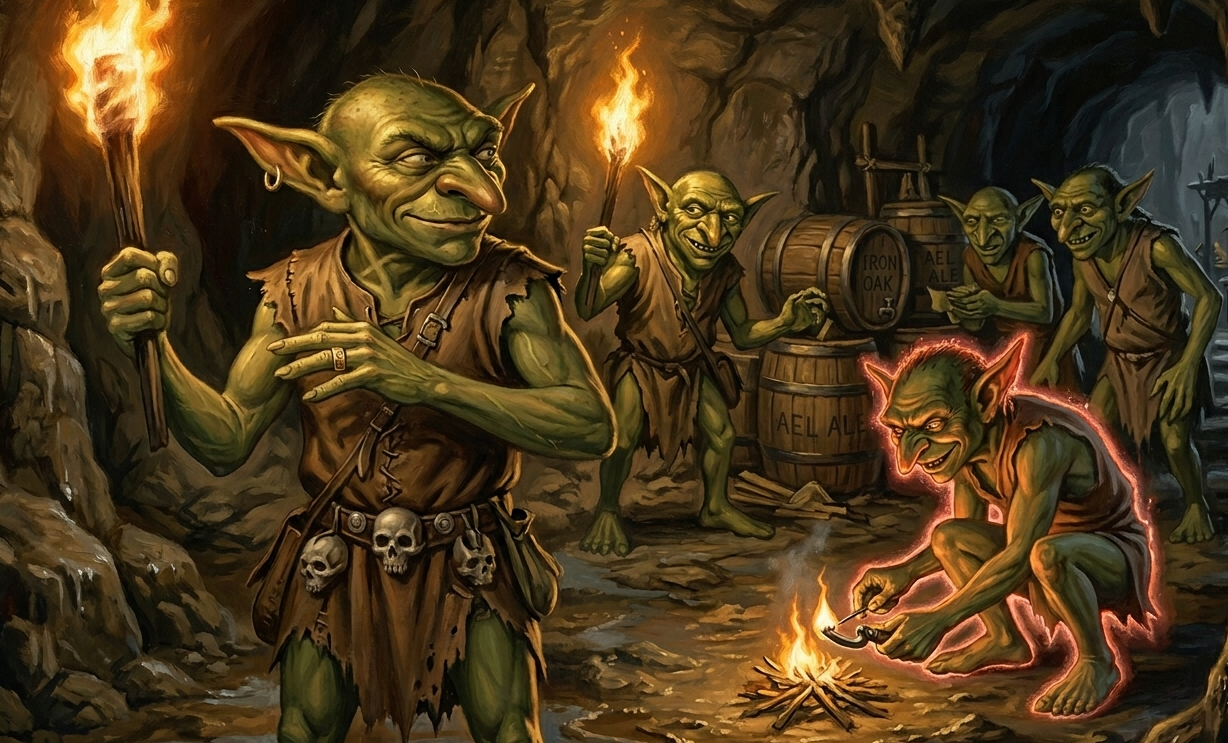
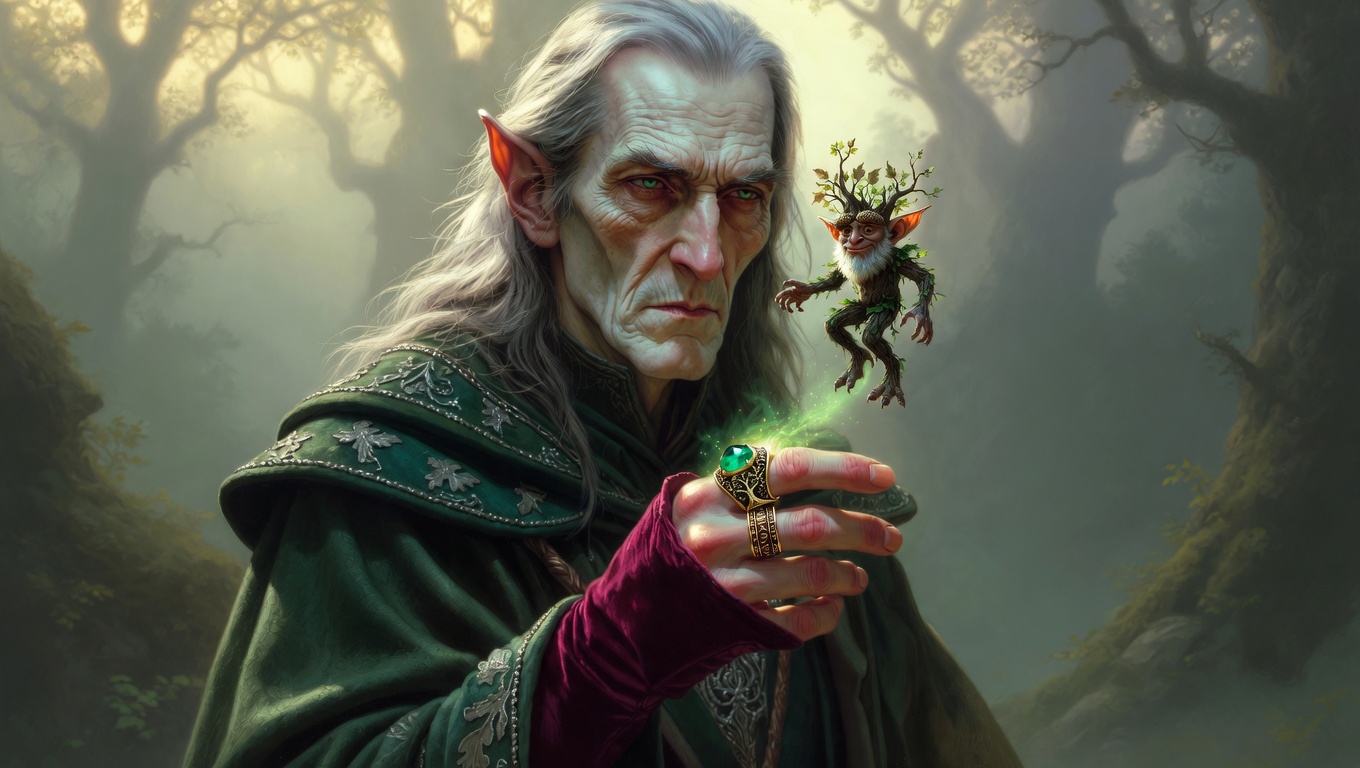
    This ring was forged by an Elven wizard of advanced age who sought to further the cause of his religion, the worship of the World Tree. He started with a cross section of a goblin’s arm bone, carefully carving it with runes an a oak motif. Into the ring, he poured a powerful enchantment that only one of Elf could use.

    At all times, the inset emerald glowed as bright as a candle, which was at times useful and other times inconvenient such that he took to wearing gloves. Whenever he wished, the glow would intensify to where it could burn skin or parchment, leaving a distinct symbol of the World Tree.

    It’s most amazing feature was the ability to summon a tree imp to serve the ring holder for up to 10 minutes.

    I worked up this ring based on the following output from the Ancient Rings generator.

    Bone Ring, highly reflective or shiny or glows, created by ancient wizard made for self made to battle for a alignment. Full powers only work for certain race Not cursed. Once a week can call a Imp to serve for a turn, Can burn signet design onto paper or brand skin

    Much of the logic behind this generator comes from a blog post on the Elfmaids and Octopi blog run by Chris Tamm. Chris is amazingly creative and inspiring, especially with the huge sets of tables for making up things like ancient rings.

    The current implementation of this generator doesn’t make the smoothest text, and it could actually grow in complexity. For example, “highly reflective or shiny or glows” really should become definitive based on a random choice.

  • Python in the Sinkhole

    Python in the Sinkhole

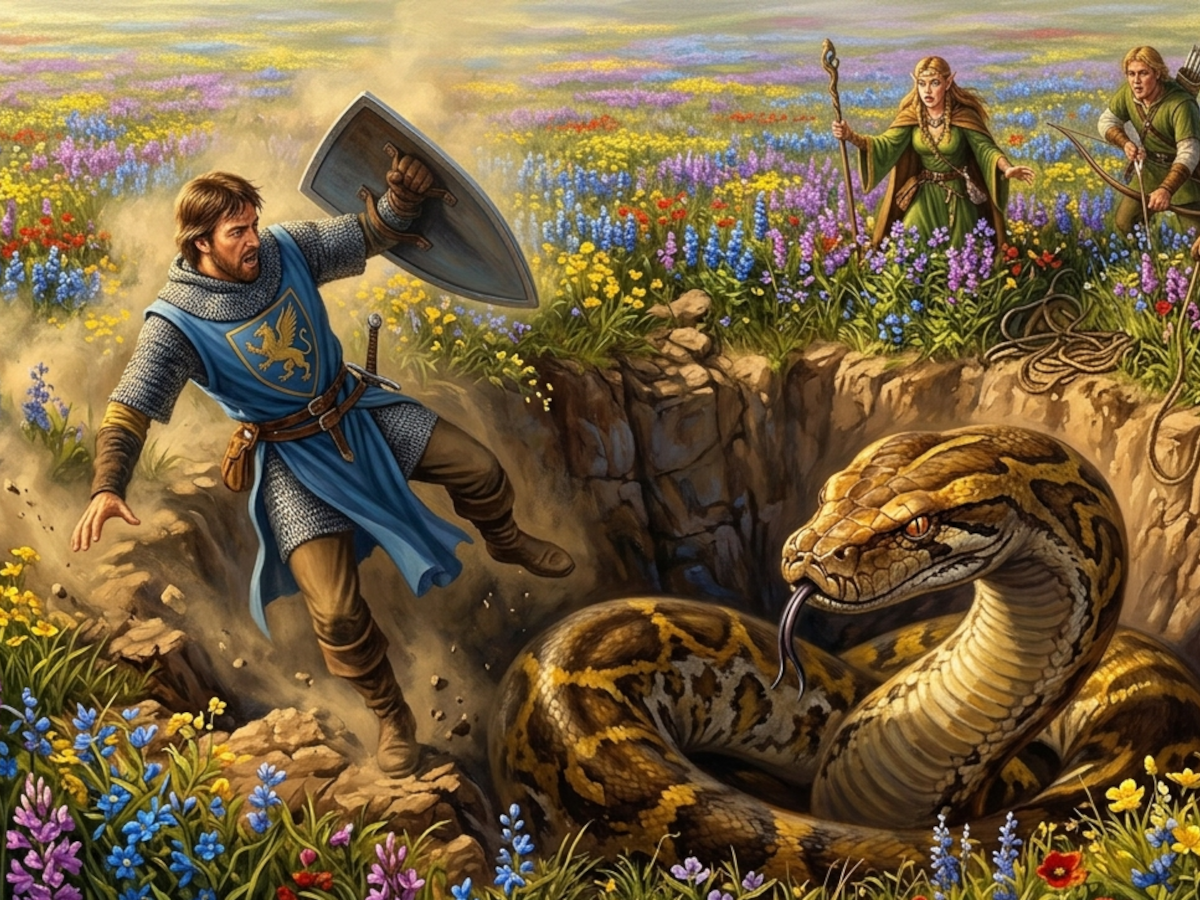
    Here’s an example of using the generator for encounters in the grasslands around St. Orlan. Most of this terrain type is far north of town, beyond the dread swamps, and it’s relatively dangerous. However, even a low level party can escape this encounter with a little luck and caution.

    The group finds themselves in an expanse of blooming wildflowers that grow waist-high. A halfling would find it especially easy to hide here, which I’d treat as +10% to hide roles or +2 to saving throws that would benefit from cover. Unfortunately, the thick cover is also hiding a sinkhole, inside of which is a giant rock python who is already in a bad mood.

    Whoever is leading the party will have to save versus death to avoid tumbling down into the sinkhole, taking 1d6 damage and then facing off with the python. The snake is going to attack immediately at the invasion of its space.

    The party is 60 yards away from the sinkhole, and they won’t be surprised by the snake when they see it. it could be inconvenient to get down into the pit to join the fight once it starts, though.

    Here’s the raw output of the genererator.

    While exploring, the party encounters figures wandering 60 yards (20 if surprised) to the northwest.
    1 Rock Pythons AC 14, HD 5, #At 1 bite/1 squeeze, Dam 1d4/2d4, Mv 30′, Sv F3, Ml 8, XP 405
    30′ long snake. Brown and yellow scales set in a spiral pattern. Its first attack is a bite. If the bite is successful, it coils around the victim and constricts in the same round. This squeezing does 2d4 points of damage per round, and occurs automatically until the snake dies or releases the victim.

    Their attitude is that there is clear and present danger. They are cautious and aware of possible trouble. They will disengage without violence if possible, or provide a final warning.

    Their surprise roll is 6, and the party rolls 4.

    The immediate area is covered by wildflowers, providing concealment for prone or small creatures (+2 bonus to stealth while moving slowly). The ground is a completely flat plain, and footing features a hidden sinkhole or depression requiring a save vs death to avoid falling 10′. Nothing much else distinguishes the area..

    The general vibe is “enrage”.

    The generator is setting up distance and surprise, but you must put those two rolls together. The snake has a reaction roll that’s just a bit towards the aggressive side, but given the vibe of “enrage”, I’m going with the snake flipping into fight mode rather than relying on more reaction rolls.

  • Sapphire Cursecoil

    Sapphire Cursecoil

    Here’s a monster that came out of the random monster generator.

    Armor Class: 19 (s)
    Hit Dice: 1+2
    No. of Attacks: 1
    Damage: 3d6 or disease (see below)
    Movement: 60′
    No. Appearing: 3d8, Lair 4d8
    Save As: Fighter: 2
    Morale: 12
    Treasure Type: F
    XP: 100

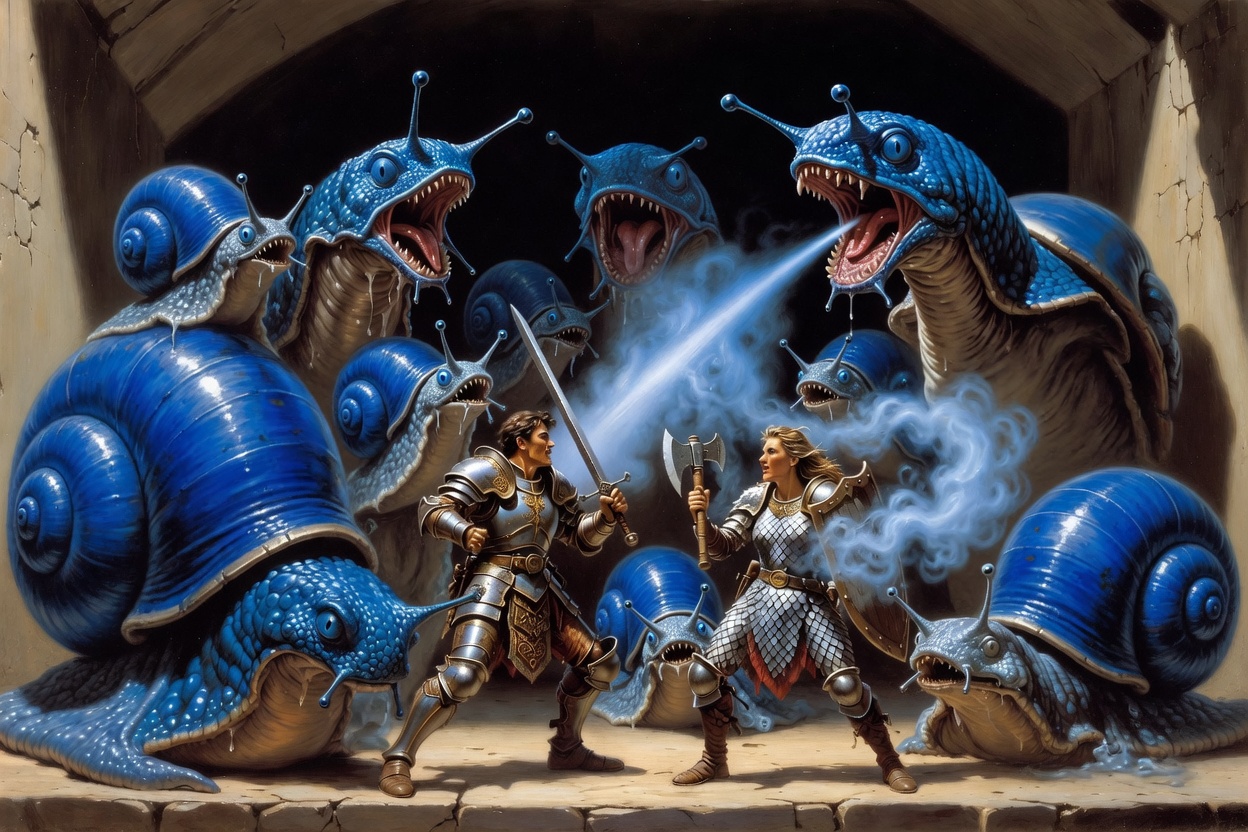
    These creatures resemble oversized blue snails, roughly 5 feet long and weighing about 166 pounds. They are highly intelligent (Intelligence 20), a cruel joke invented by a high level Magic User who fused aspects of lycanthropes and snails. As such, they can be harmed only by silver or magical weapons, and they spread their impressive numbers through a kind of magical disease or curse.

    A sapphire cursecoil attacks either by bludgeoning a foe with its head for 3d6 damage or by spraying forth a foul ichor (once per day). On a roll of 1-2 on 1d6, the victim contracts the curse that slowly transforms him into another cursecoil, progressively turning blue and folding into a snail-like shape until the change is complete. At any time before this end state, the victim may be restored with a remove curse spell. Afterwards, only a restoration spell can reverse it.

    Sapphire cursecoils are fearless and cunning, often found in groups that plan ambushes or use their curse to create more of their kind. They glide swiftly on their ventral feet, often swarming unsuspecting victims.


    Of course, I had to make some sense of the output, which was as follows.

    Armor Class = 19 (s)
    Hit Dice = 1 + 2 HD
    5 feet, 166 pounds
    Attacks = Disease or bludgeon 3d6
    Movement = 60
    No. Appearing = 3d8, 4d8 in lair
    Save As = Fighter
    Morale = 12
    Treasure Type = F
    Curse 1-2 on d6.
    Looks like a blue snail.  
    Highly intelligent (20 INT)

    A party of 4 adventurers of maybe 4th level should have a good time fighting off 15 or so of these guys. With low HD, they likely won’t land many hits, but woe to those victims that do get walloped. With 30 days to reverse the curse, it’s not too bad for PCs. The average 0-level villager has no chance.

  • Silvertongue’s Bane (The Gray Molder)

    Silvertongue’s Bane (The Gray Molder)

    I asked AI to riff on the output of the Poison Generator about this weak poison that damages charisma.

    This poison is delivered by inhaling. Its strength is considered weak, +2 to save. Its effects are felt in 2d4 hours. The poison reduces CHA by 1, save for no damage. The damage is taken all at once. The effects of the poison may be reversed with a restoration spell.

    Silvertongue’s Bane (The Gray Molder)

    Commonly known among court assassins and spiteful rivals as The Miasma of the Mundane, this fine, slate-colored powder is harvested from the desiccated spores of the Languid Lily, a pale flower that grows only in places where there is no wind and very little light.

    The Lore: How it Works

    Unlike traditional toxins that attack the blood or nerves, Silvertongue’s Bane targets the “vital spark” of an individual’s presence. When inhaled, the microscopic spores attach themselves to the victim’s vocal cords and facial capillaries.

    As the spores germinate, they don’t cause hideous boils or obvious sickness; instead, they act as a magical and physical dampener. The victim’s voice loses its melodic timbre, becoming flat and droning. Their eyes lose their luster, and their skin takes on a subtle, unwashed grayness that makes others subconsciously view them as untrustworthy or simply boring. It is the poison of choice for those who want to ruin a diplomat’s career without the messy evidence of a murder.


    Game Mechanics

    PropertyDescription
    TypeInhaled (Dust/Powder)
    Saving Throw+2 bonus to Save vs. Poison
    Onset Time2d4 Hours
    Effect-1 penalty to Charisma
    RecoveryPermanent until cured by a Restoration spell

    Special Rules

    • Subtle Onset: Because the onset is delayed and the effect is subtle, a victim who fails their save might not realize they are poisoned until they next attempt a reaction roll or a feat of persuasion.
    • The Damage: The Charisma loss occurs all at once at the end of the onset period. The victim feels a sudden, inexplicable wave of lethargy and a fading of their own confidence.

    Usage in Play

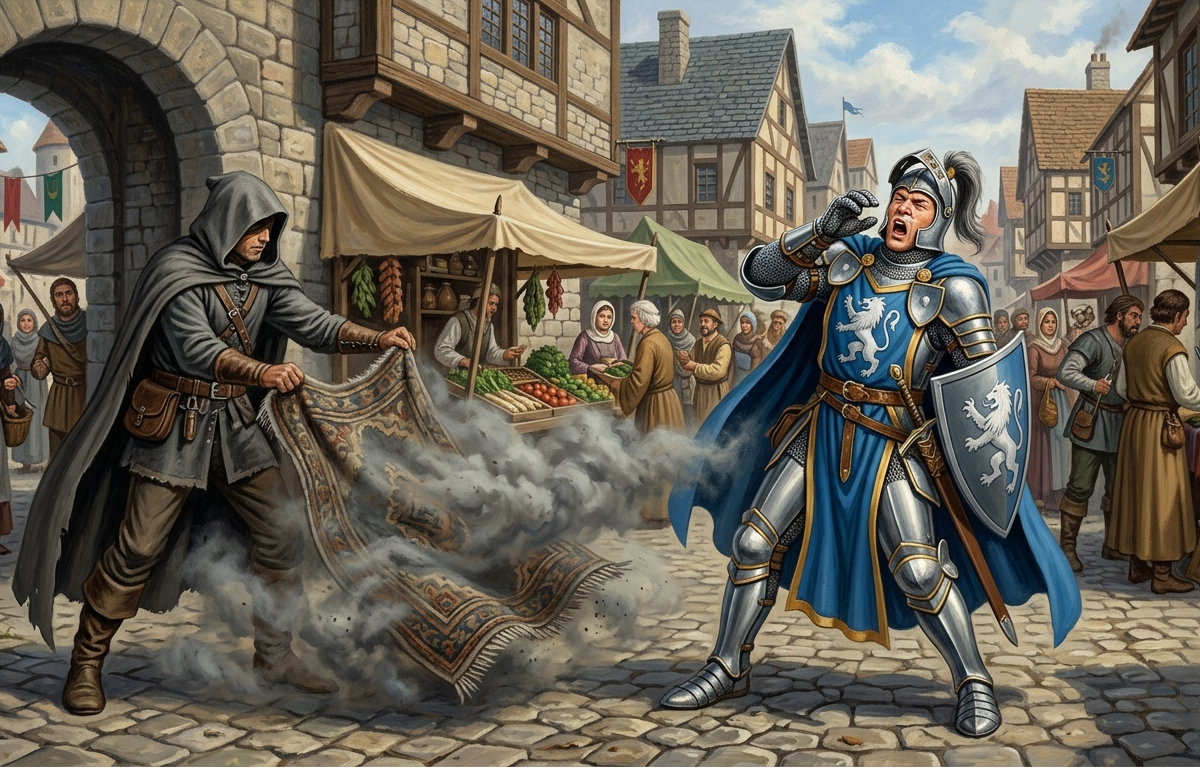
    A hooded figure in the marketplace “accidentally” shakes out a dusty rug as the Paladin walks by. The Paladin sneezes, laughs it off, and continues toward the palace. Four hours later, during the audience with the Duke, the Paladin finds his jokes falling flat, his pleas for aid sounding whiny, and the Duke looking at him with newfound disdain. The Paladin hasn’t lost his health, but he has lost the room.

  • Behold, The Beginning!

    Since 2017, I’ve been running a Basic Fantasy campaign that was intended as a way to get my two sons hooked on RPGs. It was a fathers-and-kids deal that picked up a few extra adults along the way, eventually morphing into all adults when my sons got old enough. Along the way, I built a little WordPress plugin to mechanize rolling on various random tables. At first, it was stuff out of the rule book, then a few tables adapted from blogs or other games. Today, I tend to build deep, complex generators from scratch.

    In a future post, I’ll talk about my process. Right now, I want to introduce the site. It collects the 60+ generators I built for emptyz.com, the site that keeps the house rules and session reports for the Tienarth’s Raiders campaign. In the future, I’m going to refactor my most ancient random generators from my personal site, leonatkinson.com. Being from 1997, it took a bit of wrench-twisting to them to run in PHP 8.

    Before I do that, I will be working on a generator for my latest BFRPG “module”, Estates of the Eliari.

    The entire module is a collection of lookup tables that fills out location details based on a fixed map. I’m going to make it a one-click effort to get a unique adventure.

    I also plan to write about some of the existing generators and also create new ones, of course. It looks like I’m getting involved in a Traveller campaign, so I may be building generators for that game as well.