Category: News

  • Blending Names with Markov Chains

    Blending Names with Markov Chains

    Markov Chains provide an easy way to generate unique names that seem plausible based on a list of familiar names. The Name Blender generator on One Dice Six implements this idea.

    You need names for people, places and things in your fantasy world. You can work from historical lists, such as census data. This can produce names without the right flavor (Fred the Barbarian), or they can seem unoriginal (Gandalf the Wizard). You can use use a trick such as using the middle name of a well-known character (Captain Tiberius). You can use an AI and get Lyra or Chen, over and over. You can certainly just wing it, which can lead to unintended reuse, such as The Inn of the Dancing Frog having a rival next door called The Inn of the Dancing Toad.

    Here’s another method that’s fast, makes unique names and generally produces names that all seem somewhat similar.

    The trick is to use a Markov Chain. The technique starts with a list of names that you wish to model. The names are scanned over as a sequence of letters. Take a slice of the name, maybe 3 or 4 letters, and then look at which letter comes next. Here’s a list of first names that begin with “ste”.

    • Steele
    • Stefan
    • Stefano
    • Stella
    • Stellan
    • Stephan
    • Stephanie
    • Stephen
    • Stephon
    • Sterling
    • Stetson
    • Steve
    • Steven
    • Stevie

    The letters that appear as the fourth letter are e, f, l, p, r, t, and v. Note that p appears 4 out of 14 times, and v appears 3 out of 14 times. Now, imagine we’re trying to come up with a new, unique name and we’ve picked letters at random up to having “ste”. We could construct a lookup table to pick the fourth letter at random.

    1d100Next Letter
    1-7e
    8-21f
    22-35l
    46-63p
    64-70r
    71-77t
    78-100v

    Roll a 55, and the result is p. Now you have “step”, so you refer to the lookup table for “tep”, and so forth. Except, this would be incredibly tedious if done by hand. Computers are great and analyzing a long list of names and building the many lookup tables. Furthermore, the technique is simple enough to run in your browser. Thus, we have Name Blender.
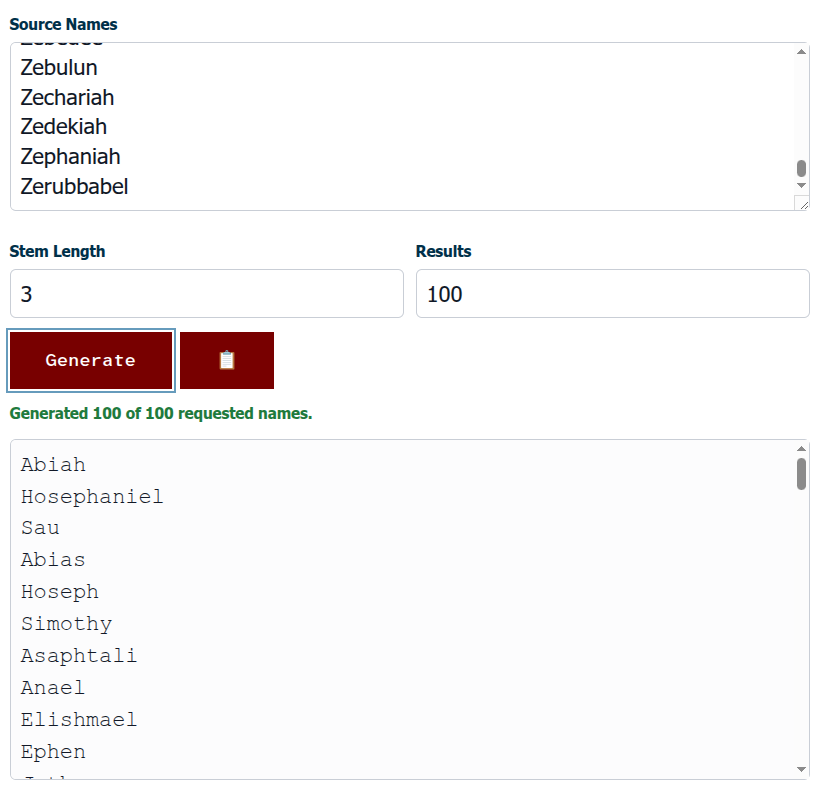
    Choosing a source list relies on your creativity and how many names you start with. In the example above, I’ve started with 172 names found in the bible. You can see with names like Hoseph and Simothy, they are clearly reminiscent of names we all recognize but they aren’t in the source list. You can get really far using names from various cultures, but what gets really interesting is when you mix two lists together.

    For example, I mixed biblical names with the 40 most popular baby names in Sweden and came up with names like Agnesimus, Malter, and Gabram. This works for place names, too. I mixed up the names of the top cities in the US and came up with Marbond, Windido, Dester, Saukeeport, Stinsonia. From ancient Greek city names I got Olynth, Phermum, Patracus, Lamphidna.

    The longer the stem length, the fewer possible results there can be and more regular the results become. Short stems tend to give results that seem more random.

    Lists of names are readily available on the Internet. Many times these lists need to be edited into just the names. You can also ask an AI to produce a like with a prompt like “give me a list of 100 Chinese given names suitable for warriors/generals from the Genghis Khan era”.
  • Save to Clipboard or File

    Save to Clipboard or File

    Every generator now offers buttons to copy the results to the clipboard or to save the results to an HTML file.

    (more…)
  • Estates of the Eliari

    Estates of the Eliari

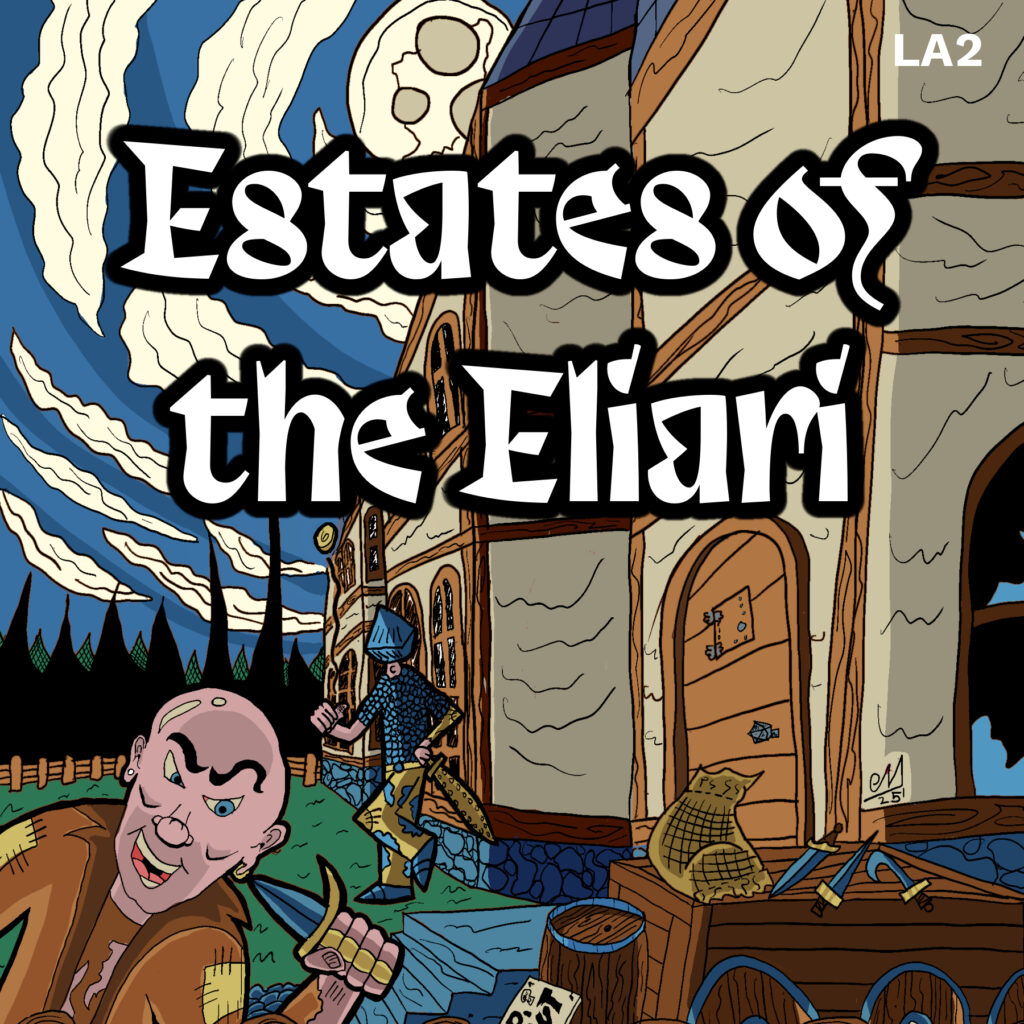
    Today, I’ve released a generator for the Estates of the Eliari module.

    Back in 2022, I was curious about whether I could build a random generator for entire dungeon that made more sense than the traditional, purely-random variety, such as those that come out of Appendix A. I was also thinking about Frontier Forts of Kelnore, the 1978 supplement published by Judges Guild. That supplement had a map that you might have to modify based on a few results, such as “a 5 foot ditch was dug around the walls”.

    I built a generator based on Frontier Forts it to get an idea of what it could produce. You can see how the results are relatively sparse, though I remember reading that players had fun with it when it was first available. I knew I could do something much more complex. And when I got into it, I discovered it was a lot of fun to keep coming up with alternate results. It was something like a solitaire version of the short-form improv game “New Choice” aka “Change”, where a bell rings and you must come up with a different response.

    This experience is similar to that of abductive reasoning that we use when making sense of random results in TTRPGs. In fact, preparing this generator was much like the whole process in reverse because I started from one result and asked my muse to tell me about how it could be different, all the while keeping in mind the context of the other parts of the adventure location. And added challenge is making sure that one result won’t introduce a contradiction that ruins verisimilitude.

    I had so much fun grinding through the possibilities, I thought others would like to join in. I posted the unfinished manuscript to the BFRPG forum, hoping for some collaboration. I didn’t get much on the creative side, so eventually built out the entire set of tables. I did benefit from the excellent editing team over there, and the module was eventually published in 2025.

    Check out the loot page for more information plus links to download the module.

    How useful or interesting is this kind of generator? Should I build another one? I’m open to suggestions.

  • Behold, The Beginning!

    Since 2017, I’ve been running a Basic Fantasy campaign that was intended as a way to get my two sons hooked on RPGs. It was a fathers-and-kids deal that picked up a few extra adults along the way, eventually morphing into all adults when my sons got old enough. Along the way, I built a little WordPress plugin to mechanize rolling on various random tables. At first, it was stuff out of the rule book, then a few tables adapted from blogs or other games. Today, I tend to build deep, complex generators from scratch.

    In a future post, I’ll talk about my process. Right now, I want to introduce the site. It collects the 60+ generators I built for emptyz.com, the site that keeps the house rules and session reports for the Tienarth’s Raiders campaign. In the future, I’m going to refactor my most ancient random generators from my personal site, leonatkinson.com. Being from 1997, it took a bit of wrench-twisting to them to run in PHP 8.

    Before I do that, I will be working on a generator for my latest BFRPG “module”, Estates of the Eliari.

    The entire module is a collection of lookup tables that fills out location details based on a fixed map. I’m going to make it a one-click effort to get a unique adventure.

    I also plan to write about some of the existing generators and also create new ones, of course. It looks like I’m getting involved in a Traveller campaign, so I may be building generators for that game as well.